



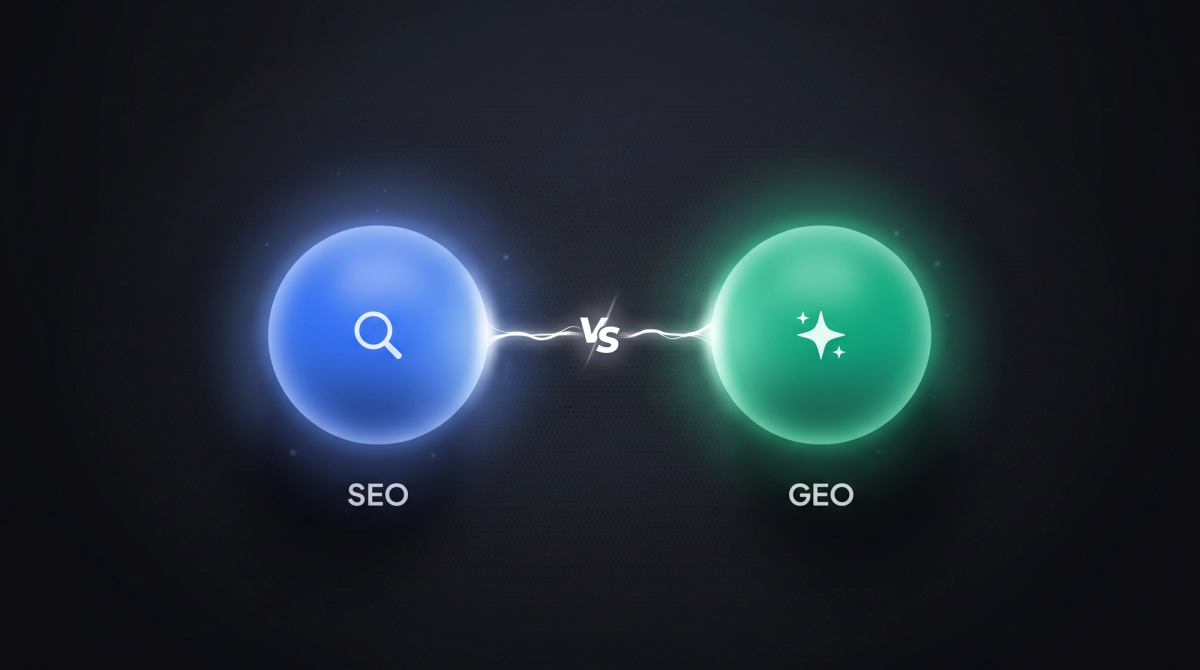
SEO vs. GEO: How your website shows up in AI answers.
Your customers no longer just google. They ask ChatGPT, Perplexity, and Gemini. Whoever does not show up there does not exist for them. How GEO works - and how it differs from classic SEO.
Imagine a potential customer asks ChatGPT: "Which agency builds high-quality B2B websites?" The AI names three. Yours is not among them. You never saw that query, never had a chance - and the customer does not even know you exist.
That is happening millions of times right now. More and more people ask their questions not on Google but directly on ChatGPT, Perplexity, or Google itself, which now serves answers as an AI summary at the top. They no longer click ten blue links. They get an answer.
That changes the rules. Classic SEO gets you to position one in the results. GEO makes sure you appear in the answer itself. This article explains the difference - and what you can concretely do.
Key takeaways
- SEO optimizes for ranking positions. GEO optimizes for being cited and recommended in AI answers.
- The two are not mutually exclusive - GEO builds on a clean SEO foundation.
- AI answer engines prefer clearly structured content: direct answers, FAQ blocks, unambiguous statements, verifiable facts.
- In German-speaking B2B, GEO is still barely occupied. Whoever starts now has a real head start.
What is the difference between SEO and GEO?
SEO - search engine optimization - you know: you optimize your page so Google shows it as high as possible for relevant terms. Success is measured in rankings and clicks.
GEO - Generative Engine Optimization - is the answer to a new reality. When someone asks ChatGPT or Perplexity something, there is no longer a results list you work your way up. There is an answer in which you either appear or not. GEO is the discipline that makes sure the AI knows your brand, understands it, and recommends it at the right moment.
The core difference: SEO fights for visibility on a page. GEO fights for a place in the answer. One brings visitors, the other brings recommendations.

Why this matters right now
Search behavior is shifting, and fast. Complex questions that used to need several Google searches are answered by the AI in one paragraph. For B2B this is especially relevant: decision-makers research providers, compare solutions, weigh options - and increasingly ask AI assistants instead of clicking through ten agency websites.
Whoever does not show up in those answers drops out of the shortlist before it even begins. And unlike with Google, you notice nothing: no impression, no click, no trace in the stats. You are simply not in the room.
How AI answer engines select content
AI models draw their answers from content they can understand and place well. Three things help especially:
Clarity. Direct answers to concrete questions get cited more than convoluted marketing prose. A sentence like "A B2B website costs from €8,000" is usable for an AI. "We offer tailored solutions for every budget" is not.
Structure. Headings as questions, FAQ blocks, short key takeaways, clean paragraphs. Content that already looks like an answer is more likely to become the answer.
Authority. Verifiable facts, real experience, consistency across multiple sources. AI models weight what seems credible and repeatedly confirmed.
What you should concretely do
- Answer real questions directly - every important page clearly and early, not in the third paragraph.
- Rely on structure: FAQ blocks, clear subheadings, key takeaways.
- Add structured data (schema markup for FAQ and articles).
- Be consistent across channels - website and external sources should match.
- Keep the SEO foundation: fast load times, clean tech, good content.
Frequently asked questions
Become visible where your customers search
Search is changing, and most websites are not built for it. If you want to know whether your site appears in AI answers - and what it needs to - we will look at it together. Just message us through our contact form.
More Articles



Let's talk about your project.
20-minute call, no sales pressure. You describe what you have in mind, we tell you if and how we can help.