



OnPage SEO: the key elements explained
What on-page SEO is, which elements really matter, and how to optimize your pages step by step. From content to title tag and meta description to internal linking, clearly separated from technical SEO, plus a checklist.
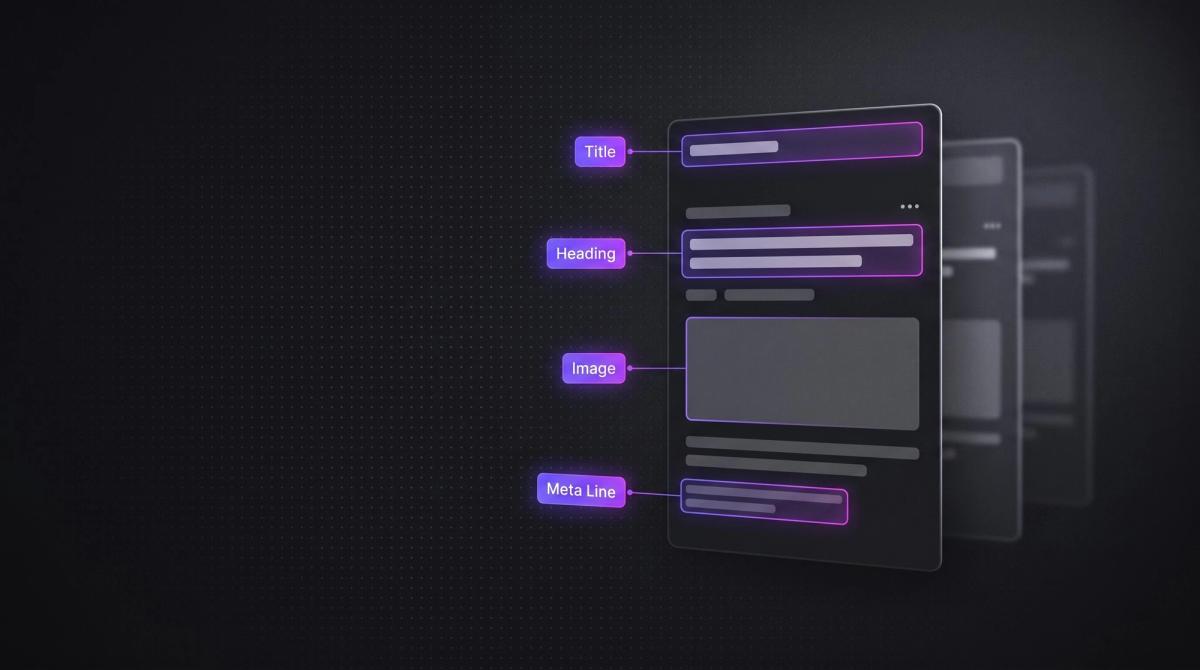
OnPage SEO is the part of search engine optimization you fully control yourself. It covers everything that happens directly on your page: title tag, headings, content, internal links, images. Google uses these signals to decide what a page is about and whether it is the best answer to a query.
This article explains what OnPage SEO actually is, how it differs from off-page and technical SEO, and which elements really matter in 2026. At the end you get a concrete checklist you can apply right away.
Key takeaways
- On-page SEO covers everything you optimize directly on your page: content, keywords, headings, title tag, meta description, internal links, images, and URL. The goal is a page that both the search engine and the human understand instantly.
- The biggest lever is the content, not a single tag. If your text matches search intent better than the competition, search engines forgive small technical flaws. The reverse is not true.
- Title tag: 50 to 60 characters or around 600 pixels, main keyword up front. According to studies, Google rewrites around 61% of all titles itself when they are too long or too vague.
- On-page is not technical SEO. On-page is what is visible on the page (content, structure, meta). Technical SEO is what is invisible behind it (crawling, indexing, load time). Both belong together but are worked on separately.
- Good on-page work pays twice: it ranks on Google and at the same time makes your page citable for AI answers in ChatGPT, Perplexity, and Google AI overviews.
What is on-page SEO?
On-page SEO, also called on-page optimization, covers all measures you take directly on a page itself to make it better for search engines and people. Everything happens on your own page, in contrast to off-page SEO, which happens elsewhere, for example through backlinks from other websites.
Roughly, on-page splits into three levels: the content level (content, keywords, images), the structural level (headings, internal links, URL), and the semantic level (title, meta, structured data). The goal is always the same: a search engine should recognize in seconds what the page is about and who it is relevant for, and a human should find exactly what they searched for. An important distinction: on-page refers to the individual page, while some sources use on-site to mean the whole domain. In practice the two terms are often used synonymously.
On-page SEO vs. technical SEO: the clear distinction
These two get mixed up constantly but need to be kept cleanly apart. The simple rule of thumb: on-page is what visitors and the search engine see and read on the page. Technical SEO is the foundation behind it that makes sure the page can be found, crawled, and delivered at all. You optimize both, but with different tools and in a different order.
On-page SEO and technical SEO compared
| On-page SEO | Technical SEO |
|---|---|
| Content and keywords | Crawling and indexing |
| Title tag and meta description | robots.txt and XML sitemap |
| Heading structure (H1 to H3) | Load time and Core Web Vitals |
| Internal linking | Server rendering and HTTPS |
| Images, alt text, URL | Canonical tags and redirects |
Which on-page elements really matter?
Not every element carries the same weight. Content and the heading structure carry most of the impact because they decide relevance and search intent. Title and meta decide whether there is a click at all. Internal links, images, and URL are important amplifiers but no substitute for weak content. We go through the elements in exactly that order, from the biggest impact to the fine-tuning.
Content and keywords
Content is the most important ranking factor of the page, no tag in the world makes up for weak content. What matters is that your text matches search intent: is someone looking for a definition, a comparison, or a buying decision? Cover the topic completely, concretely, and written for the user, not for a keyword counter.
The main keyword belongs in the important spots: in the H1, in the first sentences, in a subheading, and naturally distributed through the text. A fixed keyword density is outdated; more important are semantically related terms and synonyms that round out the topic. Two traps: duplicate content, meaning identical text across several pages, dilutes your ranking, and keyword cannibalization, when two of your pages compete for the same keyword. Assign exactly one page to each keyword. More on this in our guides to keyword research and writing SEO texts.
Heading structure (H1, H2, H3)
Headings are the scaffolding of your page, for humans and for search engines. The rule is clear: exactly one H1 per page, it describes the topic and contains the main keyword. Below it, H2 and H3 structure the content into logical sections, hierarchically and not jumbled.
Good headings do two jobs at once. They make the text scannable, since almost nobody reads word for word, and they tell the search engine which subtopics you cover. Feel free to phrase H2s as real questions, the way users ask them. That helps ranking and at the same time makes your page citable for AI answers.
Title tag
The title tag is the blue, clickable headline in the search results and one of the strongest on-page factors there is. It decides in seconds whether someone clicks or scrolls on. Keep it at 50 to 60 characters or around 600 pixels, otherwise Google cuts it off. The main keyword belongs up front, and the title should be unique for every page.
A detail that surprises many: Google regularly rewrites titles itself. Studies with tens of thousands of titles show that around 61% of all titles shown in search results are rewritten by Google, mostly because they were too long, too vague, or overloaded with keywords. A clear, on-point title in the right length is the best protection against that.
Meta description
The meta description is the short description text under the title in the search result. It is not a direct ranking factor but strongly affects click-through rate, and click-through rate indirectly affects your ranking. See it as your ad in organic search: 150 to 160 characters, containing the most important keyword, a clear benefit, and a reason to click.
Here too: Google often replaces the meta description with a more fitting snippet from your text, depending on the query. Still, a good, custom description is worth it, because for brand and core keywords it is often shown exactly as written. An empty or duplicate meta description is a wasted opportunity. All the details are in our article on the meta description.
Internal linking
Internal links connect the pages of your website with each other. They do three jobs: they guide the user to the next sensible step, they distribute ranking power (often called link juice) to your important pages, and they show Google which pages belong together and which are especially important.
The practice is simple: link thematically related pages with descriptive anchor text, not with click here. Placement matters, a link in the main navigation or in the body text weighs more than one in the footer. And your most important pages should receive many internal links so Google recognizes their importance. Whoever has few backlinks gains especially much from internal linking.
Images and alt text
Images make a page livelier, keep users longer, and can bring extra traffic via image search. For search engines to understand them, they need three things: a descriptive file name (so product-configurator-b2b.jpg instead of IMG_4831.jpg), an alt text that describes the image, and sensible compression so they do not ruin load time.
The alt text serves a double purpose. It explains to search engines and screen readers what is shown in the image, which is at the same time a building block for accessibility. Write it descriptively and naturally, with a keyword only if it fits, not as a keyword dump.
URL structure
A good URL is short, descriptive, and contains the main keyword. yourdomain.com/onpage-seo tells the user and the search engine instantly what it is about. yourdomain.com/p?id=4831 says nothing. Descriptive URLs raise the click-through rate in the results and give Google another hint about the topic.
A few rules: separate words with hyphens, no umlauts or special characters, no unnecessarily deep directories. And set the URL structure early, because later changes need cleanly placed redirects, otherwise you lose ranking. A well-thought-out URL structure is also a question of user guidance, not just technology.
E-E-A-T, freshness, and structured data
Beyond the individual elements, in 2026 Google increasingly assesses how credible a page is as a whole. The keyword is E-E-A-T: experience, expertise, authoritativeness, trust. Concretely that means: a visible author with real competence, traceable sources, current content instead of years-old versions, and a serious overall presence. Especially for topics involving money or trust, this is decisive.
On top of that comes structured data (schema markup): invisible code that additionally tells search engines what is on the page, for example an FAQ, a product, or a company. It is not a direct ranking factor but can lead to rich results in search and helps AI systems classify your content correctly. Placed honestly: schema is a sensible building block but no magic lever. The content remains the core.
On-page SEO works for Google and AI answers at the same time
Clean on-page SEO is, in 2026, the shared basis for two channels: classic Google ranking and visibility in AI answers from ChatGPT, Perplexity, and Google AI overviews. The reason is simple: AI systems preferentially cite content that is clearly structured, answers the question directly, and comes from a credible source. That is exactly what good on-page work produces anyway.
That is why an answer-oriented structure pays off: the core statement up front, H2s as real questions, short paragraphs, clear facts. That helps the Google ranking and at the same time makes your page citable. How this works in detail is explained in our article on generative engine optimization. The distinction from technical SEO remains important: on-page makes your content good, the technology makes sure search engines and AI crawlers can read it at all.
Which tools help with on-page SEO?
You do not need an expensive suite to do solid on-page work. For the basics, free tools are enough; specialized tools come in when you work systematically across many pages.
On-page tools by task
| Task | Tools |
|---|---|
| Rankings, errors, and content analysis | Ahrefs, Sistrix, SE Ranking, Semrush |
| Site crawl (missing title, meta, H1, alt) | Screaming Frog, Ryte |
| Indexing and real Google data | Google Search Console |
| Check behavior and search intent | Google Analytics 4 |
Your on-page checklist
To close, the order in which you check a single page, from the biggest impact to the fine-tuning. These five steps cover the most common on-page mistakes we see in practice: missing or duplicate titles and H1, thin content, no internal links, images without alt text, and unreadable URLs.
Check content and search intent
Does the text hit exactly what users search for? Is the topic covered completely, currently, and uniquely? Most of it is decided here.
Set the structure: one H1, clean H2/H3
Exactly one H1 with the main keyword, below it logically structured H2 and H3, ideally phrased as questions. Short, scannable paragraphs.
Optimize title and meta description
Title 50 to 60 characters with the keyword up front, unique meta description with a clear benefit. Both unique per page, never empty or duplicate.
Set internal links and URL
Link to related pages with descriptive anchor text, connect important pages more strongly. Descriptive, short URL with the keyword.
Images and finishing touches
Descriptive file names, descriptive alt text, compressed images. Finally check freshness, author, and, where useful, structured data.
Frequently asked questions
On-page SEO covers all optimizations you make directly on a page to make it better for search engines and people. This includes content, keywords, headings, title tag, meta description, internal linking, images with alt text, and the URL structure. In contrast, off-page SEO happens outside your own page, for example through backlinks.
On-page SEO is what is visible on the page: content, structure, headings, title, and meta. Technical SEO is the foundation behind it: crawling, indexing, load time, robots.txt, sitemap, and server rendering. On-page makes your content good, the technology makes sure search engines can find and read it at all. Both belong together but are worked on separately.
Content is the strongest factor because it decides relevance and search intent, no tag makes up for weak content. Right after come the heading structure with exactly one H1 and the title tag, which decides the click-through rate. Internal linking, meta description, images, and URL are important amplifiers.
Around 50 to 60 characters or about 600 pixels so Google does not cut it off. The main keyword belongs up front, and every title should be unique. Titles that are too long, too vague, or overloaded with keywords are rewritten by Google itself in around 61% of cases according to studies.
A fixed keyword density is outdated. More important than a percentage is that the main keyword appears in the central spots, in the H1, in the first sentences, in a subheading, and that you naturally include semantically related terms and synonyms. Write for the user, not for a counter, and avoid keyword cannibalization by assigning exactly one page to each keyword.
Yes. AI systems like ChatGPT and Perplexity preferentially cite content that is clearly structured, answers the question directly, and comes from a credible source, exactly what good on-page SEO produces. An answer-oriented structure with the core statement up front, H2s as real questions, and clear facts helps the Google ranking and at the same time makes your page citable for AI answers.
More Articles


Let's talk about your project.
20-minute call, no sales pressure. You describe what you have in mind, we tell you if and how we can help.