




What is a landing page? Definition, structure, examples
A landing page is a single page with exactly one goal: a conversion. What a landing page is, how it differs from a homepage and a website, what types exist, what a good one consists of, and when it pays off.
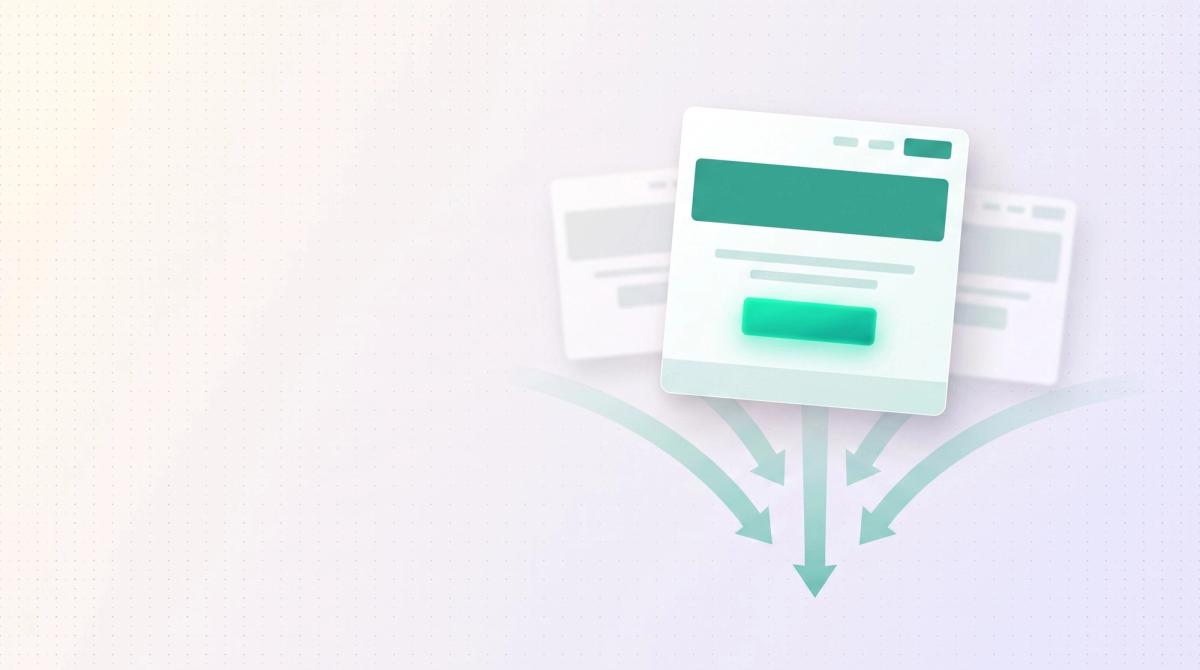
Landing page, homepage, start page, website. These terms get thrown around constantly but do not mean the same thing. A landing page is something very specific: a page built for a single goal that leaves out everything else.
This article explains briefly and definitively what a landing page is, how it differs from a homepage and a website, what a good landing page consists of, when it pays off, and which mistakes kill the conversion.
Key takeaways
- A landing page (Landeseite, Zielseite in German) is a single page with exactly one goal: a conversion, meaning a specific action like an inquiry, a download, or a purchase.
- The difference from a homepage: the homepage is the broad entrance with many paths. The landing page is a focused dead end with only one next step and no navigation.
- There are two basic types: the lead generation page with a form and the click-through page with a single button. Everything else is a variation of these.
- Dedicated landing pages convert noticeably better than a homepage: median around 4 to 6.6% versus around 2.35% for general pages (Unbounce, WordStream 2026).
- A good landing page answers four questions within seconds: where am I, what do I get, how do I get it, why is it worth it. The rest is craft.
What is a landing page?
A landing page, also called Landeseite or Zielseite in German, is a single web page built for exactly one goal: to move the visitor to take a specific action. That action is called a conversion. It can be a purchase, an inquiry, a download, a newsletter sign-up, or a booked appointment. The name comes from the fact that visitors land on this page after clicking a link, for example in a Google ad, an email, a social media post, or an organic search result.
The decisive difference from a normal subpage is focus. A landing page does not present your entire company or list all your services. It revolves around a single offer and guides the visitor distraction-free toward a single next step. Anything that distracts from that step is deliberately left out, often even the main navigation. Less choice means more decision here.
Landing page, homepage, website: where is the difference?
The three terms get mixed up constantly but mean different things. The website is the whole thing, all your pages together under one domain. The homepage is the start page of that website, the broad entrance that gives an overview and branches in many directions. The landing page is a single, focused page with only one goal and usually no menu.
An image for it: the homepage is the reception hall with doors into every department. The landing page is the direct corridor to exactly the one room the visitor was looking for. That is why a dedicated landing page usually converts noticeably better than the homepage when both get the same campaign traffic. WordStream and Unbounce show a 2026 median around 2.35% for general pages and, depending on the source, around 4 to 6.6% for dedicated landing pages.
Homepage vs. landing page side by side
| Homepage | Homepage | |
|---|---|---|
| Purpose | Give an overview, show the brand | Trigger one conversion |
| Navigation | Full menu, many paths | Usually none, one next step |
| Content | Broad, all services | One offer, one focus |
| Traffic source | Direct, brand, navigation | Ad, email, campaign |
| Conversion (2026 median) | ~2.35% | ~4 to 6.6% |
What types of landing pages are there?
At their core, almost all landing pages come down to two basic types. Whoever understands these two understands all the variations that guides often present as a long list.
The lead generation page, also called a lead capture page, has a form at its heart. The goal is to collect contact data: name, email, sometimes company or phone number. It is the standard case in B2B and everywhere the decision takes longer and the actual sale happens in a conversation. A special case is the squeeze page, a particularly minimalist lead page that asks only for the email address.
The click-through page has no form but a single button. It explains an offer and sends the visitor onward with one click to the actual goal, for example into the checkout or a sign-up. It is typical in e-commerce and software, where the next step is possible right away.
The common landing page types
| Type | Goal and typical use |
|---|---|
| Lead generation (lead capture) | Form collects contact data. Standard in B2B, consulting, and high-priced offers. |
| Click-through | One button forwards to checkout or sign-up. Typical in e-commerce and software. |
| Squeeze page | Minimalist lead page, usually asks only for the email address. |
| Event / registration page | Informs about a webinar, conference, or appointment and leads to sign-up. |
| Product / offer page | Digital storefront for a single product or service. |
What does a good landing page consist of?
A good landing page answers four questions right on the first scroll, questions every visitor asks unconsciously: where am I, what do I get, how do I get it, and why is it worth it for me. If the page does not answer these questions immediately, the visitor is gone. From that follow the building blocks found on almost every strong landing page. How you then fine-tune and test these blocks is covered in our article optimize your landing page.
A clear headline and a value promise
The headline is the most important element. In a few words it says what the visitor gets and why it matters to them, not how great your company is. A supporting subline delivers the second half. What matters is the match: the promise of the ad the visitor came from must reappear in the headline. Whoever clicks on cheap men’s shoes and sees swimwear bounces immediately.
A single, clear call-to-action
The call-to-action is the heart of the page. A landing page ideally has exactly one primary action, no competing offers. The CTA button should name the benefit, not the effort: Start a free consultation works better than Submit form. On longer pages the same CTA may appear several times so it is always within reach when the decision ripens.
Trust signals and social proof
People act when doubt is smaller than desire. Testimonials, logos of known clients, real references, numbers, and awards lower the perceived risk. In B2B, traceable results and concrete cases count more than star ratings. Place these signals where the decision is made, right next to the CTA.
A lean form
If your landing page collects contact data, the form is a central friction point. Ask only for what you truly need. The numbers are clear: forms with three fields convert noticeably better than those with nine fields, according to Unbounce. Every extra field costs completions. When in doubt, ask for less and follow up later.
Fitting visuals and mobile display
A meaningful main image, often called a hero shot, reinforces the message and shows the offer. Just as important is the mobile display. Mobile traffic is usually the majority today, so the landing page must be responsive and work just as clearly on the phone as on the desktop. Fast load times are part of that, because every extra second costs conversions.
Do not forget the legal essentials
In Germany especially, an imprint (Impressum), a privacy policy, and for shops the terms and conditions belong on every landing page, linked so they are easy to find. Whoever collects contact data or newsletter sign-ups via a form also needs a double opt-in process in which the user confirms the sign-up by email. This is not optional but legally required and protects you from cease-and-desist warnings.
When is a dedicated landing page worth it?
A dedicated landing page is worth it whenever you steer targeted traffic to a specific goal. The classic case: you run Google Ads or LinkedIn ads. Sending that traffic to the homepage wastes money, because the homepage is too broad. A matching landing page whose message fits the ad exactly gets far more out of the same ad budget.
Other typical occasions: a product launch, a whitepaper or webinar for lead generation, a time-limited promotion, a special audience or language variant of a campaign. Whenever you want a clear action and can keep the path to it free of distraction, a landing page is the right tool. For pure brand and overview functions, the homepage stays in charge.
Common landing page mistakes
Most weak landing pages fail not on details but on the same basic mistakes. Too many goals on one page: whoever wants three things at once gets none of them right. Full navigation that leads the visitor away again instead of guiding them to the one goal. A break between ad and page, so the promise of the ad is not fulfilled on the landing page. A form that is too long and asks for more than the visitor wants to give at that point. And missing trust, when neither references nor a face nor clear details show who is behind the offer.
These mistakes are conversion killers, but all avoidable. How to find and fix them systematically is shown in our articles on conversion optimization and optimizing your landing page.
Landing pages in B2B: what really matters
In B2B nobody spontaneously buys a contract through a button. The decision stretches over weeks, several people are involved, and the close happens in a conversation. For your landing page that means the conversion is rarely the purchase but the qualified inquiry or the booked intro call. The type of choice is almost always the lead generation page with a short, honest form.
Two things are decisive here. First, trust: traceable cases, real references, and a page that radiates competence technically and visually. Second, clarity: a message that speaks to exactly the right audience, and a next step that is low-threshold. This is exactly where our work starts. We build B2B websites and landing pages where structure, message, load time, and trust-building are designed for conversion from the start, instead of repairing them after the fact.
Frequently asked questions
A landing page is a single web page with exactly one goal: to move the visitor to a specific action, such as an inquiry, a download, or a purchase. You land on it after clicking a link, for example in an ad or email. Unlike the homepage, it shows only one offer and usually no menu.
The homepage is the start page of your website, a broad entrance with a menu that gives an overview and branches in many directions. The landing page is a focused single page with only one goal and usually no navigation. That is why a dedicated landing page usually converts noticeably better than the homepage for campaign traffic.
At the core, two: the lead generation page with a form to collect contact data, and the click-through page with a single button that forwards, for example, to the checkout. Variations include the minimalist squeeze page, event and registration pages, and product or offer pages.
A clear headline with a value promise, a single distinct call-to-action, trust signals like references and testimonials, on lead pages a lean form, a fitting main image, and a mobile, fast-loading display. In Germany, an imprint, privacy notice, and where relevant a double opt-in must not be missing.
It depends heavily on industry, offer, and traffic. For orientation: the median of dedicated landing pages in 2026 is around 4 to 6.6% depending on the source (Unbounce, WordStream), while general pages tend to sit around 2.35%. The most meaningful comparison, though, remains your own baseline.
As soon as you steer targeted traffic to a specific goal, for example via Google Ads or a campaign, a dedicated landing page is almost always worth it. It gets more out of the same budget than the overly broad homepage. For pure brand and overview functions, the website stays in charge.
More Articles



Let's talk about your project.
20-minute call, no sales pressure. You describe what you have in mind, we tell you if and how we can help.