




Conversion optimization: the honest guide
What conversion optimization really is: calculating conversion rate, honest benchmarks, the key levers, the most common conversion killers, and the systematic CRO process. With a clear B2B focus.
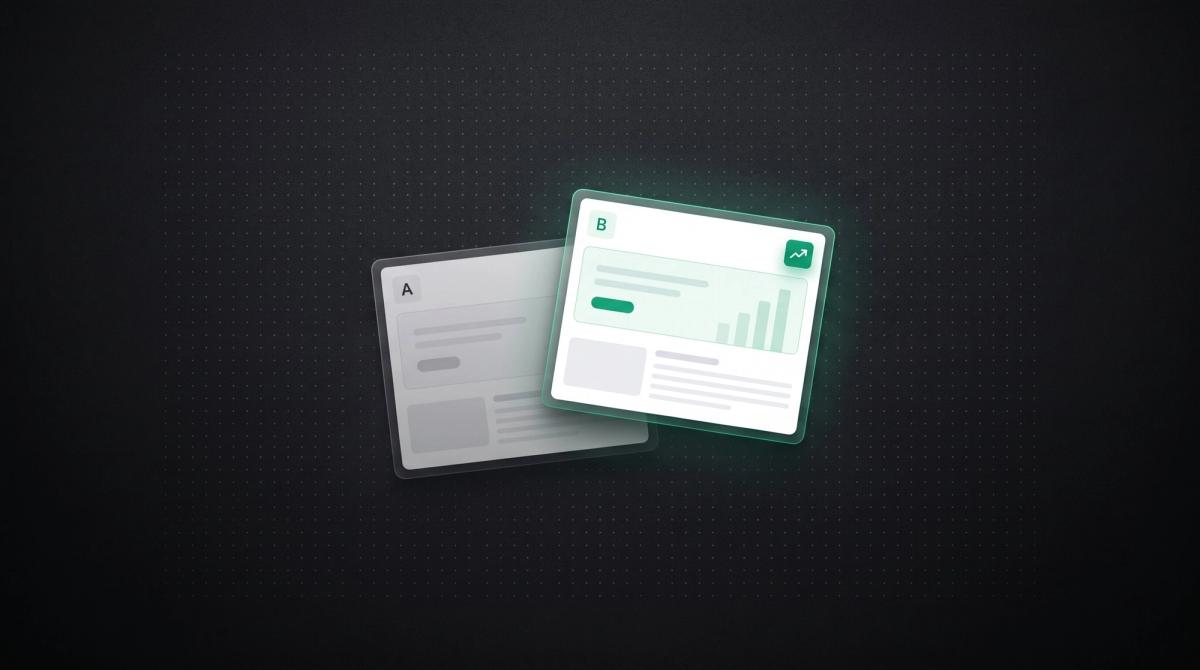
More visitors help little if almost none of them become customers. This is exactly where conversion optimization comes in: it gets more out of your existing traffic instead of simply buying more traffic. That is almost always cheaper than the next campaign.
This article explains what conversion optimization is, which levers really count, and how to work systematically instead of from the gut. And it shows the point most guides skip: in B2B, CRO works differently than in the online shop. Honestly, without a bag of tricks.
Key takeaways
- Conversion optimization (CRO) increases the share of your visitors who take a desired action. You get more from the traffic you already have instead of buying expensive new traffic.
- The formula: conversion rate = (conversions / unique visitors) x 100. Calculate with unique visitors, not visits.
- There is no universal good conversion rate. Professional services sit around 4.6% in 2026, B2B SaaS around 1.1%. Your own baseline is the only meaningful benchmark.
- The principle behind every conversion: motivation must be greater than friction. You raise motivation or remove friction, usually both.
- CRO is a process, not a trick: measure, hypothesize, test (A/B), evaluate, implement, repeat. Changes without data are guessed, not optimized.
What is conversion optimization (CRO)?
Conversion optimization, also called conversion rate optimization or CRO, is the ongoing process of increasing the share of your website visitors who take a specific, desired action. That action is called a conversion. Instead of buying more visitors, you get more out of the visitors who already come.
A distinction helps here. A macro conversion is the big goal: a purchase, an inquiry, a signed contract. A micro conversion is a step toward it: a newsletter sign-up, a whitepaper download, starting a configurator. In B2B especially, where decisions take weeks, these micro conversions are the real lever. Whoever optimizes only for the purchase overlooks the ten small steps before it, where visitors actually drop off.
The principle: motivation beats friction
Every conversion follows the same simple logic. A visitor acts when their motivation is greater than the friction in their way. Motivation is the desire to solve a problem. Friction is everything that makes the path there tiring: a confusing layout, a form that is too long, an unclear next step, a missing trust signal.
That leaves exactly two levers. You raise motivation by making the value clearer and more credible. Or you lower friction by removing steps, shortening forms, and clearing up doubts. Almost every concrete CRO measure falls on one of these two sides. This picture helps you prioritize instead of blindly tweaking buttons.
How do you calculate the conversion rate?
The formula is simple: conversion rate = (number of conversions / number of unique visitors) x 100. The word unique matters. Calculate with unique visitors, not visits or page views, otherwise you distort the result. If ten people visit your page five times each and all ten buy, you have a 100% conversion rate, not 20.
An example: 10,000 unique visitors, 200 purchases, that gives a conversion rate of 2%. At an average order value of 50 euros, that is 10,000 euros in revenue. Raise the rate to 2.5% through optimization and revenue climbs to 12,500 euros, without a single extra visitor. That is exactly what makes CRO so economical: the lever works on traffic you have already paid for.
A tip from practice: calculate the conversion rate per goal and per page, not just globally. A landing page, a product page, and your contact form have completely different jobs and values. A global average blurs exactly the spots you should be working on.
What is a good conversion rate?
The honest answer: it depends. Blanket figures of 1 to 4% circulate everywhere but are worth little in practice, because industry, offer, price, and traffic source shift the number completely. Only the comparison with your own baseline is meaningful. As rough orientation, here are current 2026 benchmarks:
Average conversion rates by context (2026)
| Context | Conversion rate |
|---|---|
| Professional services | ~4.6% |
| Industrial / B2B general | ~4.0% |
| E-commerce average | ~2.9% |
| B2B SaaS | ~1.1% |
| Desktop vs. mobile | ~3.1% vs. ~1.8% |
| Traffic from AI search (ChatGPT, Perplexity) | ~3.5% vs. ~2.9% organic |
The most important conversion levers
Before you test, it pays to get the basics right. These levers work on almost any website because they either raise motivation or lower friction. They are the starting point when your analysis has not surfaced a more urgent issue yet.
A clear message
Within the first seconds a visitor must understand what you offer, who it is for, and why it is better. A headline that says everything and nothing costs you more conversions than any button color. State concretely what the visitor gets, not how great you are.
One goal and a strong CTA
Every page needs one primary action. Too many equally weighted options paralyze the decision. The call-to-action should name the benefit, not the effort: Start a free consultation works better than Submit form. Phrase it from the visitor’s perspective, not from your process.
Social proof and trust
People convert when doubt is smaller than desire. Testimonials, logos of known clients, case numbers, awards, and real references lower the perceived risk. In B2B, concrete results and traceable cases count more than star ratings. Place trust signals exactly where the decision is made, not just in the footer.
Load time and performance
Every extra second of load time costs conversions, especially on mobile. Technical basics like fast response times, optimized images, and stable layouts are not a pure developer topic but direct conversion factors. Measure your Core Web Vitals and fix the obvious first.
Simple forms
Forms are one of the biggest friction points there is. Ask only for what you truly need. Every extra field lowers the completion rate. For longer flows it helps to split them into steps and show progress instead of demanding everything at once. Placeholder hints in the field reduce errors and frustration.
Mobile first
Mobile traffic is often the majority today but converts noticeably worse than desktop. That gap is rarely an accident, it signals buttons that are too small, forms that are too long, or restless layouts on small screens. Optimize the mobile experience on its own terms, not as a shrunken desktop version.
The most common conversion killers
Often the problem is not that something is missing but that a mistake in the basics actively drives visitors away. These four killers are the ones we see most in practice.
Confusing navigation
If visitors do not find what they are looking for immediately, they go to a competitor. Good navigation guides instead of forcing guesswork. As a rule of thumb: prefer few items across several levels over an overloaded menu with more than seven options. And whatever is important belongs in the main navigation, not hidden in the footer.
Hidden key pages
Your most valuable pages, such as references, pricing, or a guide, must not be reachable only via detours. If a page drives conversions but nobody finds it, you leave revenue on the table. Link the pages that matter for the buying decision prominently and provide a working internal search.
Complicated checkout and form abandonment
When visitors start the process and drop off midway, that is an urgent signal. According to the Baymard Institute, the most common reasons are unexpected extra costs, a forced account requirement, and too few or wrong payment methods. Show all costs early, allow guest checkout and contact without an account, and keep the final step as short as possible.
Missing trust
An anonymous imprint, no references, no visible security, no face. In this flood of providers, trust decides. If visitors cannot tell who is behind the page and whether the offer is legitimate, they abandon it, even with a perfect offer. Show real people, real results, and make the next steps transparent.
Systematic instead of guessing: the CRO process
Getting the basics right takes you far. But real optimization is a scientific loop, not a gut feeling. Best practices are things that worked for others in the past. Whether they work for your audience today, you only know once you measure it.
Data before gut feeling
Start with analysis. Web analytics like Google Analytics 4 shows where visitors come from and where they drop off. For behavior on the page itself, heatmap and session tools like Hotjar, Microsoft Clarity, or Mouseflow help: they show what gets clicked, how far people scroll, and where users get stuck. In B2B with little traffic especially, these qualitative tools often give more insight than raw numbers.
Form and prioritize hypotheses
From the analysis you form clear hypotheses in the pattern: if I change X, then Y happens, because Z. Then you prioritize by effort and expected return. Start with measures that are easy to implement and effective at the same time, at the bottom of the funnel, where visitors are already ready to buy. Landing pages and checkout first, informational content later.
Set up A/B tests correctly
In an A/B test you compare two variants with real visitors. Three rules decide the validity. First: test only one element at a time, otherwise you do not know what worked. Second: run the test until you reach statistical significance, at least one full business cycle, often one to two weeks. Third: document every test, including the losers. Even a failed test gives you an insight about your audience.
Implement and iterate
What wins gets rolled out on all relevant pages. Then the loop starts again, because CRO is never finished. Your audience changes, technology changes, and there is always a next element to improve. Whoever starts early and keeps going gains the biggest lead over time.
Conversion optimization in B2B is different
In B2B nobody spontaneously buys an enterprise contract through a button. The decision stretches over weeks, several people are involved, and the actual close often happens in a conversation, not on the page. According to Gartner, up to 85% of sales interactions now happen digitally. For your website that means the conversion is rarely the purchase but the qualified inquiry, the booked intro call, the whitepaper download.
That is why in B2B, micro conversions and trust count more than any buy-button trick. Optimize the path to the inquiry: clear presentation of services, traceable cases, a short contact or booking form, and a website that radiates competence technically and visually. An interesting side effect of AI search: visitors coming via ChatGPT or Perplexity tend to convert better than classic organic traffic because they arrive with higher intent. One more reason to be visible in AI answers.
This is exactly where our work starts: we build B2B websites where structure, load time, message, and trust-building are designed for conversion from the start, instead of optimizing them after the fact.
Frequently asked questions
Conversion optimization (CRO) is the ongoing process of increasing the share of your website visitors who take a desired action, such as a purchase, an inquiry, or a sign-up. Instead of buying more traffic, you get more out of your existing traffic.
Conversion rate = (number of conversions / number of unique visitors) x 100. Always calculate with unique visitors instead of visits or page views. With 200 purchases and 10,000 unique visitors, the conversion rate is 2%.
It depends heavily on industry and offer. For orientation: professional services sit around 4.6% in 2026, e-commerce around 2.9% on average, B2B SaaS around 1.1%. The only truly meaningful comparison is your own baseline.
Common reasons are confusing navigation, hidden key pages, a complicated checkout or an overly long form, and missing trust signals. Add technical brakes like slow load times. Usually it is a combination of too much friction and too little visible motivation.
CRO is not a one-off project but an ongoing process. Individual A/B tests need at least one business cycle, often one to two weeks, to be statistically meaningful. Noticeable improvements in overall conversion emerge across several test rounds, not overnight.
To start, a web analytics tool like Google Analytics 4 and a behavior tool like Hotjar, Microsoft Clarity, or Mouseflow for heatmaps and session recordings are enough. For structured A/B tests, specialized testing tools come in later. More important than the tool is the clean process behind it.
More Articles



Let's talk about your project.
20-minute call, no sales pressure. You describe what you have in mind, we tell you if and how we can help.