


LLM SEO (LLMO): how ChatGPT and others cite you
LLM SEO, usually called LLMO, is optimizing so that language models like ChatGPT, Gemini, and Claude cite your content. How LLMs pick their sources, why Bing is the gatekeeper, the technical catch with JavaScript, and how you write answer-first for AI citations.
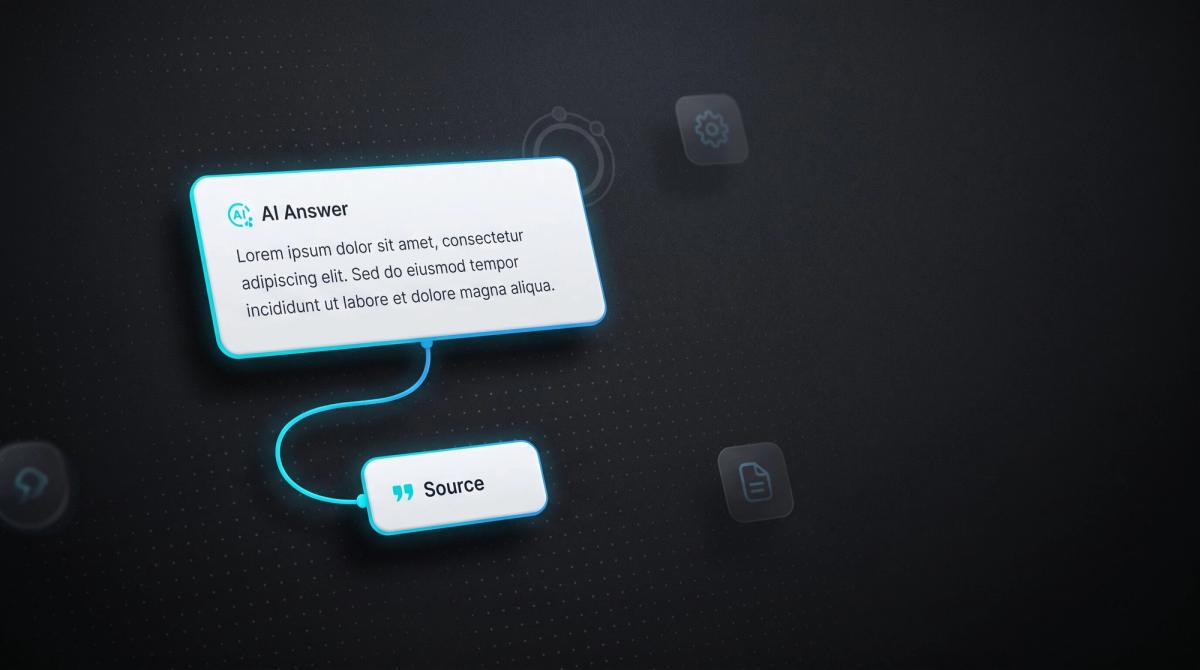
More and more people no longer type their question into Google but into ChatGPT, Perplexity, or Gemini. They get a finished answer with a few cited sources and recommended providers. LLM SEO, mostly shortened to LLMO, is the work of making sure you are one of those sources.
This article clarifies the term, shows how a language model technically decides which page it cites, and what you can concretely optimize. We stay honest, including about the parts currently overrated. LLM SEO is one part of the broader discipline [Generative Engine Optimization](/wissen/generative-engine-optimization), which we explain separately.
Key takeaways
- LLM SEO, usually LLMO (Large Language Model Optimization), is optimizing so that language models like ChatGPT, Gemini, and Claude cite your content and name your brand. It is about the answer, not about rank one.
- LLMs do not rank URLs, they select sources and shape an answer from them. The lever is not manipulating training data but Retrieval Augmented Generation (RAG): pulling live from a search index.
- Bing is the quiet gatekeeper. ChatGPT, Copilot, and Meta AI pull from Bing’s index. Whoever is invisible on Bing practically does not exist for ChatGPT’s live search.
- Rank one is no longer required. According to Semrush, nearly 90% of ChatGPT-cited sources come from positions beyond the top 20. The best answer beats the highest ranking.
- The technical catch first: AI crawlers like GPTBot and ClaudeBot do not render JavaScript. Without server-side rendering, ChatGPT and Claude see an empty page.
What is LLM SEO (LLMO)?
LLM SEO, usually abbreviated as LLMO (Large Language Model Optimization), is the discipline of building content so that large language models like ChatGPT, Google Gemini, and Claude cite it, name your brand, or recommend it in their answers. Where classic SEO aims for a ranking in the results list, LLMO aims to become part of the generated answer itself.
The key difference in mindset: with SEO you split content by keywords and search intent. With LLMO everything revolves around answers. The smallest building block of an AI answer is not the URL but the single, extractable statement. Your job is to deliver the clearest, best-evidenced, and most easily citable answer on the web for your customers’ questions.
LLMO is not an isolated topic but the part of Generative Engine Optimization (GEO) sharpened for language models, the umbrella term for visibility across all AI answer systems.
LLMO, LLM SEO, GEO, AEO: sorting the terms
The field is still terminologically chaotic because it is young and there is no single standard. These are the terms you meet most often. Important: in practice they are often used synonymously, the split is gradual rather than hard. What separates AEO from GEO in detail is in answer engine optimization.
The terms at a glance
| Term | Focus |
|---|---|
| GEO | Generative Engine Optimization. Umbrella term for visibility across all AI answer systems. |
| LLMO / LLM SEO | Focus on the language models themselves: ChatGPT, Gemini, Claude. The angle of this article. |
| AEO | Answer Engine Optimization. Focus on direct answers, featured snippets, and AI overviews. |
| GAIO / AI-SEO | German catch-all terms, mostly used synonymously with GEO/LLMO. |
How language models pick their sources
From training, a language model only knows how words statistically relate, not what is currently happening in the world. For ChatGPT and others to answer fresh, correct questions, they need a search function. That is exactly what Retrieval Augmented Generation (RAG) does: the model pulls live content matching the question from a search index and forms the answer from it.
That is the real optimization lever. Influencing a model’s training data would only be possible at huge scale and is barely controllable. Your findability in the respective index, on the other hand, you can improve directly. What matters is therefore which index an engine uses, because that determines where you need to be visible:
Which engine searches over which index
| Engine | Index |
|---|---|
| ChatGPT, Copilot, Meta AI | Bing |
| Google Gemini / AI overviews | |
| Perplexity | own index plus Bing |
| Claude | Brave |
Why Bing is the quiet gatekeeper
This is the point most underestimate: for live search, ChatGPT looks through Bing’s eyes. Thanks to the Microsoft and OpenAI partnership, Bing is ChatGPT’s official gateway to the current web, and the same holds for Copilot and Meta AI. Concretely: if your page is invisible or poorly ranked on Bing, it practically does not exist for ChatGPT’s live search.
Studies by Seer Interactive show that around 87% of SearchGPT citations match Bing’s top results. Bing optimization is therefore no longer a nice-to-have but a hard precondition for ChatGPT visibility. For most German companies that is good news, because Bing is far less contested than Google.
Three concrete steps: register your site in Bing Webmaster Tools and submit your sitemap. Make sure Bingbot and OAI-SearchBot are not blocked in robots.txt. And note that LinkedIn belongs to Microsoft, which is why signals from there land particularly well on Bing. Which engines use which index is in AI search engines at a glance.
The technical catch: AI crawlers do not read JavaScript
Before content even counts, it has to be readable, and this is exactly where many websites fail. AI crawlers like GPTBot, ClaudeBot, and PerplexityBot do not render JavaScript. They read the HTML like a browser from 2010. If your content is only assembled in the browser via JavaScript, ChatGPT and Claude see an empty page. The only notable exceptions are Google Gemini, which uses the normal Googlebot infrastructure, and Applebot.
The consequence is uncomfortable but clear: server-side rendering (SSR) or statically generated pages (SSG) are the basic precondition, not a nice-to-have. A website that is not technically AI-readable can have great content and still not get cited.
That is exactly why LLMO is not a pure content topic for us. It starts at the architecture of the page. We build websites so that every important piece of content already sits in the HTML source, with clean structured data (schema) and fast load times. Whoever ignores this optimizes text for a machine that never sees it.
How do you write content that LLMs cite?
Once the technical foundation is in place, the preparation decides. Language models prefer content that answers a question directly, clearly, and with evidence. These four levers work strongest. They not only raise the chance of a citation but also make your content better for real readers.
Answer first, then the details
Answer the question in the first sentences of every important page and every chapter before going deep. LLMs preferentially extract short, self-contained statements from the upper part of a page. A conclusion that only comes in the last paragraph is rarely cited. Phrase headings as real questions, the way your customers ask them.
Semantic chunking and clear structure
Break your content into short, clearly separated sections, each focused on a single idea. Use a clean heading hierarchy, lists, tables, and comparisons. Consistently use the same terms instead of shifting synonyms, because fuzzy language weakens what the model infers from your text. Structure here is not a design detail but the way the machine understands your meaning at all.
Unique substance instead of summary
LLMs skip interchangeable summaries and prefer substance. Deliver your own data, concrete numbers, benchmarks, case examples, or quotes that others cannot simply copy. Vercel’s litmus test: ask yourself whether a competitor could easily replicate your content tomorrow. If yes, go deeper. Exactly this information gain makes you the preferred source.
FAQ format and real user questions
Language models are trained on huge amounts of question-and-answer content, among others from Reddit and Quora. That is why they understand the FAQ format particularly well. Build real questions and concise answers around your core topics. You find the right questions in people-also-ask boxes, in follow-up questions from ChatGPT dialogs, in support tickets, and in sales. How to turn that into content that also ranks classically is shown in writing SEO texts.
LLM SEO vs. classic SEO: what is really new
In short: SEO optimizes for a ranking that brings clicks. LLMO optimizes for being cited and recommended, often with no click at all. The key mental break: rank one is no longer required. According to a Semrush study, nearly 90% of ChatGPT-cited sources come from result positions beyond the top 20. Your detailed expert article on page five has a higher chance of being cited than a competitor’s shallow post at position three, provided your answer is more convincing.
Still, LLMO is not a replacement for SEO but the layer on top. LLMs preferentially cite what is already findable on Bing and Google, and good SEO delivers exactly the crawlability, structure, and freshness that RAG also depends on. The full comparison, where the two split and where they converge, is in our article SEO vs. GEO.
Why LLMO matters now (the numbers)
Demand does not disappear, the path to the answer changes. According to Gartner, the volume of classic search queries could drop by around 25% by 2026, because AI assistants deliver answers directly. ChatGPT reached around 900 million weekly active users in February 2026, up from 400 million a year earlier. The trend is clear.
What matters for B2B, though, is not the volume but the quality of this traffic. Visitors coming via ChatGPT convert noticeably better than classic organic traffic because they arrive with an already-answered question and higher intent. A Seer Interactive case study measures around 16% conversion from ChatGPT traffic versus 1.8% from organic Google traffic. Few but high-quality visitors beat many lukewarm ones.
For you that means: being named in the AI pre-selection increasingly decides whether you make the shortlist at all, before anyone visits your website.
Honest reality check: what is overrated
LLMO is being heavily hyped right now, and not every tactic delivers. Three points worth placing honestly:
The llms.txt file. Much discussed, effect so far unproven. Audits show that hardly any major AI crawler even requests it. It does no harm, but it is not a lever worth your time.
Special content just for machines. Pure AI filler text with no real value for readers does not work sustainably. Targeted optimization for individual AI answers is also fragile, because results fluctuate strongly on vague queries. Better to optimize all content by LLMO best practices on principle than to fiddle with individual snippets.
Schema as a magic bullet. Structured data is important for machine readability but moves AI citations less than often claimed. Schema yes, but not as THE LLMO trick. The foundation stays clean SEO plus real expertise and off-site authority. Around 82% of AI-cited links are earned media from third-party sources, which is why mentions in directories, on LinkedIn, and in trade articles count more than any technical trick on your own page. How to build such mentions and links systematically is in building backlinks.
Check where you stand
Ask ChatGPT, Gemini, and Perplexity your customers’ typical questions and see whether and how your brand appears. That is your baseline.
Secure technical readability
Server-side rendering, clean structure, and fast load times so GPTBot and ClaudeBot can capture your content at all.
Become visible on Bing
Bing Webmaster Tools, submit sitemap, do not block crawlers. ChatGPT sees the web through Bing’s eyes.
Write answer-first
The most important statement up top, headings as real questions, short chunks, FAQ, unique data.
Build authority beyond your own site
Directories, LinkedIn, reviews, and trade articles. Around 82% of AI citations come from third-party sources.
Measure your visibility
Query fixed prompt sets monthly and count mentions. Track AI referrers in GA4 via a regex filter.
First steps for your company
The order above is chosen deliberately: first measure, then secure technical readability, then become visible on Bing, then build content and authority, then measure again. LLMO is not a one-off project but an ongoing process, because the AI systems change fast. Models re-crawl the web regularly, and stale content gets cited less often.
A concrete step-by-step guide specifically for ChatGPT is in our article How your company shows up in ChatGPT answers. For us, LLMO starts at the technical base: we build B2B websites that are server-side rendered, cleanly structured, and fast, so your content can be read by AI crawlers and cited by language models instead of disappearing into an empty page.
Frequently asked questions
LLM SEO, usually called LLMO (Large Language Model Optimization), is optimizing content so that language models like ChatGPT, Gemini, and Claude cite it in their answers and name your brand. Unlike classic SEO, it is not about a ranking but about becoming part of the AI answer itself.
Language models pull matching content live from a search index via Retrieval Augmented Generation (RAG) and form the answer from it. So you do not optimize the training data but your findability in that index, plus answer-first, clearly structured, citable content on a technically AI-readable page.
No. Demand does not disappear, the path to the answer changes. LLMs preferentially cite content already findable on Bing and Google. SEO stays the foundation, LLMO is the additional layer on top. Together they secure visibility in classic and AI search.
ChatGPT uses the Bing index for live search, as do Copilot and Meta AI. Studies show that around 87% of SearchGPT citations match Bing’s top results. If your page is invisible on Bing, it practically does not exist for ChatGPT’s live search. Bing Webmaster Tools and a clean sitemap are mandatory.
No. According to Semrush, nearly 90% of ChatGPT-cited sources come from positions beyond the top 20. What matters is not the position but whether your content answers the question best, clearest, and with the most evidence. A deep expert article on page five can beat a shallow one at position three.
Usually it is JavaScript. AI crawlers like GPTBot and ClaudeBot do not render JavaScript and only see the raw HTML. If your content is only assembled in the browser, the page stays empty for them. The fix is server-side rendering or static generation so every important piece of content is already in the source.
Generative Engine Optimization
The umbrella term and how AI visibility works overall.
SEO vs. GEO
The comparison and why the two belong together.
Show up in ChatGPT answers
The step-by-step guide for ChatGPT.
Answer Engine Optimization
How you land in direct answers and snippets.
Headless CMS explained
What it is, when it pays off and when it does not.
Sanity, Contentful or Storyblok
Three headless CMS compared: pricing, locales, preview.