

Funnel thinking in web design - inside conversion structures.
How to think and structure a website along the marketing funnel: awareness, consideration, decision, and care, which page type belongs on which stage, which CTAs fit, and how internal guidance moves visitors toward the inquiry. With a clear B2B focus.
Many websites feel like digital brochures. They present everything at once: products, copy, images, menus. The result? Users feel overwhelmed, jump back and forth between topics - and quickly lose interest.
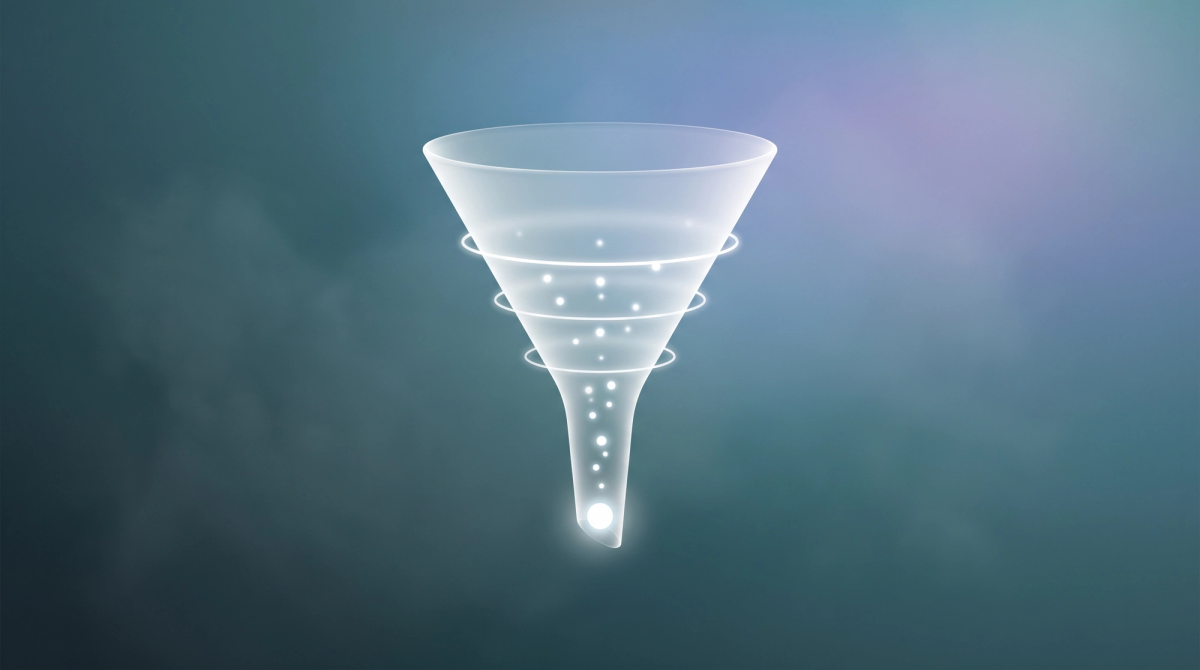
Successful websites think differently. They work like a funnel: they capture attention, build interest, create trust, and lead step by step toward action. Every section of the page has one clear job. And that logic maps perfectly onto scrolling behavior.
Key takeaways
- Funnel thinking in web design means structuring your website along the buying journey: not one page for everyone, but the right page, message, and action for each funnel stage.
- The most common model splits the funnel into three stages: top (TOFU, awareness), middle (MOFU, consideration), and bottom (BOFU, decision). Each stage needs its own page type.
- The most common website mistake is treating all visitors like ready-to-buy customers. Someone arriving in awareness mode bounces at a hard buy-now CTA.
- In B2B, funnel thinking is a must in 2026: according to Gartner and Forrester, buyers complete around 70% of their decision before contacting sales. Your website is the funnel, not just a business card.
- Every page needs exactly one next step that matches its funnel stage: read on in awareness, compare in consideration, inquire in decision. Internal linking guides instead of dead-ending.
What does funnel thinking in web design mean?
Funnel thinking in web design means building your website not as one big brochure but as a guided path along the buying journey. The marketing funnel describes the stages a person moves through before becoming a customer: from first awareness through weighing options to the decision. Funnel thinking means providing the right page, the right message, and the right next step for each of these stages.
The key shift in perspective: not every visitor is at the same point. Some are googling a problem for the first time and do not even know you exist. Others are already comparing three providers and looking for the final reason to say yes. A website that treats both the same loses both. One is overwhelmed by a hard buy-now button, the other cannot find the pricing. Funnel thinking solves exactly this by sorting pages by buying intent instead of internal department logic.
Important: this is about structure and page architecture, not the detailed optimization of individual pages. How to tune a specific page for more inquiries is in our articles on conversion optimization and landing page optimization. This text gives you the map above it.
Which funnel models should you know?
You do not need to memorize a model, but you should know the three most common ones, because they describe the same idea from different angles. They do not contradict each other, they complement each other.
AIDA is the oldest, formulated back in 1898. It describes four psychological phases: attention, interest, desire, action. AIDA explains what happens in the visitor’s head and is therefore the basis for messaging and sequence on a single page.
TOFU / MOFU / BOFU is the most practical model for website structure. It splits the funnel into top of the funnel (awareness), middle of the funnel (consideration), and bottom of the funnel (decision). We use exactly this three-way split in a moment to assign page types.
See-Think-Do-Care by Avinash Kaushik (2013) adds an often forgotten fourth stage: care, meaning existing customers and advocates. The strength of this model is sorting by intent instead of funnel mechanics, which fits the reality of modern, non-linear buying journeys especially well. For practice, TOFU/MOFU/BOFU plus the care stage in the back of your mind is enough.
Which page belongs on which funnel stage?
This is where funnel thinking gets concrete. The central idea: each funnel stage has its own job, and that requires its own page type with its own message and its own next step. Someone arriving in awareness mode wants to learn, not buy. Someone arriving in decision mode wants proof and a clear path to the inquiry. The mapping below is the practical core of this article.
Top of the funnel: pages that get discovered
On the awareness stage, visitors arrive who have a problem but do not know your brand yet. The job of the page is not to sell but to get found and show competence. Suitable page types are blog and guide articles, a knowledge or glossary section, studies, and informative overview pages. Content like this is also preferentially cited by search engines and AI answers. The next step here is deliberately soft: a related article, a download, a newsletter. A hard buy CTA at this point drives away more than it brings. How to write such content so it gets found is in writing SEO texts.
Middle of the funnel: pages that convince
On the consideration stage, the visitor knows they want to solve a problem and is now comparing approaches and providers. The job of the page is to build trust and make your approach tangible. Suitable page types are service and solution pages, references and case studies, comparison and how-it-works pages, whitepapers and webinars. Here you show how you work and what results you deliver. The next step can get more concrete: read a case study, request a whitepaper, hint at an intro call without pushing yet.
Bottom of the funnel: pages that close
On the decision stage, the visitor is basically convinced and looking for the final reasons to say yes plus a frictionless path to get there. The job of the page is to clear doubts and make the inquiry as easy as possible. Suitable page types are the contact and inquiry page, pricing and package pages, demo or booking, offer landing pages. Trust signals belong right at the decision here: real references, concrete results, transparent next steps. The CTA is now unambiguous and names the benefit, for example Book a free intro call. How to sharpen exactly these pages is in landing page optimization. What such a page realistically costs is in landing page costs.
Care: pages that turn customers into advocates
The funnel does not end with the purchase, and neither does your website. On the care stage it is about existing customers: onboarding areas, help and knowledge bases, customer portals, an ongoing blog. Satisfied customers become repeat buyers and referrers here. In B2B especially this is the cheapest growth channel, because a real reference convinces more than any ad. Many websites forget this stage entirely and give away the most valuable part of the customer relationship.
What does the funnel structure look like on a website in practice?
The following table summarizes the mapping: funnel stage, matching page type, goal of the page, and the CTA that fits. Use it as a checklist when planning your page structure or a menu. If a stage has no page of its own, you have a gap in the funnel where visitors drop off.
Funnel stage, page type, goal, and matching CTA
| Funnel stage | Page type | Goal | Matching CTA |
|---|---|---|---|
| TOFU (awareness) | Blog, guides, knowledge, glossary | Get found, show competence | Read on, newsletter, download |
| MOFU (consideration) | Services, case study, comparison | Build trust, show approach | Read case study, get whitepaper |
| BOFU (decision) | Contact, pricing, booking | Clear doubts, ease the inquiry | Book intro call, inquire |
| Care (retention) | Onboarding, help, customer portal | Retain customers, win referrers | Refer, support, upsell |
How do you guide visitors through the funnel?
Page types alone are not enough. The funnel only works if you actively guide visitors from stage to stage instead of leaving them in dead ends. Three principles decide this.
One goal per page. Every page needs exactly one primary next step that matches its funnel stage. A blog article does not have to sell, it should lead to the next fitting page. Too many equally weighted options paralyze the decision. The strongest mistake is a buy-now button on an awareness page.
Internal linking as funnel logic. Your internal links are the corridors in the funnel. A guide links to the matching service page, the service page to a case study, the case study to the contact form. That turns individual pages into a path. Side effect: this structure also helps SEO, because it signals relevance and context.
CTA matched to intent. The call to action must fit the stage. Soft at the top, concrete at the bottom. Set the hard CTA too early and you lose awareness visitors. Leave it off at the bottom and you lose ready-to-buy ones. The art is to offer the right step at the right moment, not the same one everywhere.
Why is funnel thinking decisive in B2B in 2026?
In B2B, funnel thinking is not optional but foundational. The reason lies in a shift that is measurable in 2026: according to Gartner and Forrester, B2B buyers complete around 70% of their decision before they even talk to sales. According to 6sense, buyers largely define their requirements 83% of the time before making first contact. That means the biggest part of the buying journey happens quietly on your website, without anyone from your team present.
For your website this has a hard consequence. It is no longer the digital business card next to the actual sale, it is the sale, at least the decisive 70%. If a prospect does not find the awareness content that meets them, the consideration proof that convinces them, and the clear decision path that leads them to the inquiry, they drop out of your shortlist before you even know about them. On top of that: a typical B2B purchase involves several people in the buying center, all at different points in the funnel, all looking for answers on your website.
This is exactly where our work starts. We build B2B websites as a funnel from the structure up: with pages for each stage, clear internal guidance, and trust signals right where the decision is made. A corporate website designed as a funnel works for you even when nobody from sales is online. For startups starting with a limited budget, exactly this structure is the difference between presence and sales channel, more under web design for startups.
Frequently asked questions
Funnel thinking means structuring the website along the buying journey: each funnel stage (awareness, consideration, decision, care) has its own page type with a matching message and next step. That turns the website from a static catalog into a guided path that moves visitors toward the inquiry step by step.
TOFU (top of the funnel) is the awareness stage where visitors discover you, for example via blog and guide articles. MOFU (middle of the funnel) is the consideration stage where you convince with service pages and case studies. BOFU (bottom of the funnel) is the decision stage where contact, pricing, and booking pages lead to the close.
The marketing funnel makes people aware of you and qualifies them into prospects, mostly quietly via your website and content. The sales funnel picks up afterward and takes a qualified lead to the close, often in a personal conversation. For website structure the marketing funnel matters most, because that is where most of the pre-selection happens.
The three most common are AIDA (attention, interest, desire, action) as a psychological model, TOFU/MOFU/BOFU as a practical structure model, and See-Think-Do-Care by Avinash Kaushik, which adds the care stage for existing customers and advocates. They do not contradict each other but describe the same buying journey from different angles.
Every website meant to generate inquiries or sales already has a funnel, planned or not. The only question is whether it is designed on purpose. Without funnel thinking, all visitors land on the same pages with the same prompts, no matter how far along they are. With funnel thinking, everyone gets the fitting next step, which noticeably increases conversion.
Funnel thinking is the structure, conversion optimization is the fine work on individual pages. First you make sure the right page exists for each stage of the buying journey and that visitors are guided along the path. Then you optimize each of these pages for its specific job. Without the right structure, any single-page optimization runs empty.