

ChatGPT Ads: what they are worth for B2B
ChatGPT Ads have run in Germany since 24 Aug 2026. Costs, format, targeting, privacy, and why we think they are overrated for B2B companies right now.
ChatGPT Ads are paid ads that OpenAI has shown below ChatGPT answers in Germany since 24 August 2026, and only to users on the Free and Go plans. Since 31 August, any company based in Germany can book them itself in the OpenAI Ads Manager, starting at a daily budget of 15 euros. Everything in this article reflects the situation as of October 2026. The product is still officially in beta and is changing fast.
We deliberately do not run ChatGPT Ads for INSYNC. You get the short answer first, then the facts on launch, costs, format, targeting and ad rules, a comparison with Google Ads and organic AI mentions, the first published test numbers, and our recommendation.
Key takeaways
- Since 24 Aug 2026, ChatGPT has shown ads in Germany, only on the Free and Go plans. Plus, Pro, Business, Enterprise and Edu stay ad-free.
- Self-serve booking has been open since 31 Aug 2026 in the OpenAI Ads Manager (beta), from 15 euros a day, billed per impression, per click or conversion-optimized.
- Delivery is driven by conversation context and free-text context hints, not keywords. Personalized ads are currently unavailable in the EEA and Switzerland.
- Under OpenAI's ad policies (version of 10 Sep 2026), law firms cannot advertise outside the US, and finance and health offers generally cannot either.
- OpenAI itself has no benchmarks yet. Two published tests from June 2026 reached click-through rates of 0.65 and 1.30 percent, but hardly any sign-ups or leads.
- Our decision: we do not run ChatGPT Ads. The ad sits below a finished answer, and the recommendation inside the answer is worth more.
The short answer
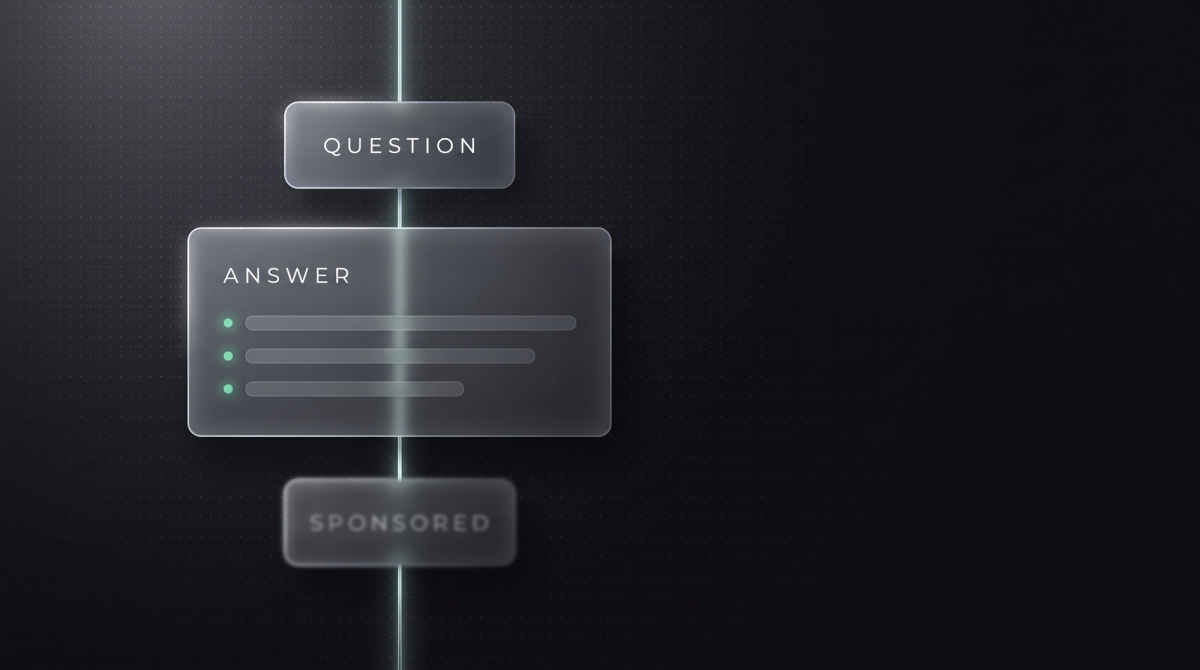
ChatGPT Ads are context-based ads that appear below a ChatGPT answer and are labeled "Sponsored". In Germany they have been live since 24 August 2026, visible only to users of the free version and the low-cost Go plan. Companies book them in the OpenAI Ads Manager from a daily budget of 15 euros and pay per 1,000 impressions, per click, or optimized for conversions (as of October 2026).
Unlike Google Ads, there are no keywords. The system reads the ongoing conversation and your description of the situations in which your offer helps. According to OpenAI, ads do not influence answers, and advertisers do not see any chats.
For B2B companies with long buying cycles, we currently consider the format overrated. The ad only shows up once the question has already been answered. Being named as a recommendation inside the answer gets you further.
What are ChatGPT Ads and where do they appear?
ChatGPT Ads are ad cards below an answer. According to the OpenAI Help Center, each ad consists of the advertiser name, a favicon (the small logo icon of a website), a title, short copy, an image and a link to the landing page. The card is labeled as sponsored and visually separated from the answer. It appears when the system detects a matching need in the current conversation. Someone asking for a recipe might see a grocery delivery service underneath.
Who sees ads depends on the plan. The free version and ChatGPT Go, the lowest-priced paid plan, are affected. Plus, Pro, Business, Enterprise and Edu stay ad-free. Accounts that OpenAI identifies as belonging to minors get no ads. Ads do not appear next to topics such as personal health, mental health or politics.
For your planning, this means a buyer who uses ChatGPT through their company's Business or Enterprise workspace will never see your ad. So before any test, check how your target customers use ChatGPT: privately on the free plan or through a company account.
Since when has ChatGPT shown ads in Germany?
OpenAI tested ads in the US first and then opened the market in several stages. It took a little over seven months to reach Germany.
- 16 January 2026: OpenAI announces ads on the Free and Go plans and sets out principles such as answer independence and conversation privacy.
- 9 February 2026: Testing starts in the US for logged-in adults.
- 5 May 2026: Self-serve Ads Manager launches in beta, adding cost-per-click buying next to impression-based buying.
- 18 August 2026: Announcement for 31 European markets, including Germany, Austria, France and the Netherlands.
- 24 August 2026: First ads in Germany.
- 31 August 2026: Self-serve booking in the Ads Manager across all 31 European markets.
According to OpenAI, tens of thousands of marketers had advertised on ChatGPT by August. To book yourself, your company's legal entity must be based in an enabled country. The Help Center lists 56 countries, including all EU member states (as of October 2026).
What do ChatGPT Ads cost and how does booking work?
You book in the OpenAI Ads Manager, an ad account that feels a lot like Google Ads. The structure is familiar: a campaign with objective, budget and run time, ad groups with context hints below it, and the individual ads below those. Every ad goes through a review before it runs.
Billing and minimum budget
You pick one of three objectives. "Views" bills on CPM, meaning per 1,000 impressions. "Clicks" bills on CPC, meaning per valid click. "Conversions" optimizes for an action such as an inquiry or purchase and bills as oCPC or oCPM: still per click or per 1,000 impressions, just with automated bidding.
According to the OpenAI Help Center, the minimum daily budget is 15 euros, 20 Swiss francs or 25 US dollars (as of October 2026). The daily budget is an average across seven days. On a single day the system may spend up to twice that amount, and at most seven times it per week. For click campaigns, OpenAI recommends starting with a maximum bid of 3 to 5 US dollars per click. That recommendation is stated in US dollars. You pay afterwards by credit card whenever a payment threshold is reached.
Format and character limits
You do not get much room. Under OpenAI's upload specs, the title may have at most 50 characters, with 16-24 recommended. The ad copy may run up to 100 characters, with 32-48 recommended. Add a square image of at most 1,200 by 1,200 pixels.
The landing page must be reachable for OAI-AdsBot, the crawler OpenAI uses to check advertised pages automatically. If your robots.txt (the file that allows or blocks crawler access), your firewall or a login blocks this bot, the ad gets stuck in review. OpenAI recommends also allowing OAI-SearchBot, the crawler behind ChatGPT search.
Targeting by conversation context
Instead of keywords, you write context hints: short sentences describing the situation in which your offer helps. The OpenAI Help Center gives examples such as "Bookkeeping software for growing retailers that need to reconcile online and in-store sales". The hints are explicitly not keywords and not fixed rules. They only help the system judge when an ad might be relevant. On top of that, you set locations, down to postal codes where available, and platforms: Android app, Android web, desktop web, iOS app and iOS web.
Measurement runs through the OpenAI Pixel, a script on your website, and the Conversions API, an interface through which your server reports inquiries or purchases directly. Integrations with Google Analytics 4 and HubSpot are available. Before launch, check with your data protection officer how the pixel fits into your consent banner. According to OpenAI, spend shows up in reporting with a delay of seven to eight hours.
Who may advertise on ChatGPT and what about privacy?
For many consulting and legal firms, the decision is made right here. OpenAI's ad policies (version of 10 September 2026) exclude legal services outside the US. Financial services and health offers are "generally" prohibited outside the US. Political content, gambling, alcohol, tobacco and dating, among others, are off-limits everywhere. A German law firm therefore cannot use ChatGPT Ads at the moment, however large its budget.
On privacy, Europe has tighter limits than the US. According to the Help Center, personalized ads based on past chats or saved memories are not available in the European Economic Area (EEA, meaning the EU plus Iceland, Liechtenstein and Norway) or in Switzerland. Selection then relies mainly on the current conversation and the ad itself. OpenAI also states that conversations are not shared with advertisers, data is not sold, ads run on separate systems and do not influence answers. Advertisers only receive aggregated metrics such as impressions and clicks.
How do ChatGPT Ads differ from Google Ads?
With Google Ads, you buy search terms. When someone types "B2B website agency", your ad can sit above the results before they have read anything. With ChatGPT Ads, there is no search term to buy. The system decides based on the conversation, and the ad only follows once the answer is complete. The third option is the organic mention: the AI names your company inside the answer because the sources support it. You pay no media costs for that, you invest in content, technology and mentions. Our guide on how to show up in ChatGPT answers covers the practical side.

How do ChatGPT Ads differ from Google Ads?
| Criterion | ChatGPT Ads | Google Ads (Search) | Organic mention in AI answers |
|---|---|---|---|
| Trigger | Conversation context and context hints | Booked search terms | Content, sources, mentions of your brand |
| Position | Below the finished answer, labeled "Sponsored" | Above or below search results, labeled as an ad | Inside the answer itself |
| Who sees it | Free and Go users aged 18+ | Everyone searching on Google | Users on every plan, including Plus and Business |
| Billing | Per 1,000 impressions, per click or conversion-optimized | Mostly per click | No media costs, effort for content and tech |
| Minimum budget | 15 euros a day (as of October 2026) | Daily budget freely set | No per-click budget |
| Personalization in the EEA | None for now | Audiences within consent limits | Not applicable |
| Law, finance, health | Excluded or generally prohibited outside the US | Per Google policies, some with requirements | No ad policy, sources decide |
| Data available | Beta, no benchmarks yet per OpenAI | Established for years, plenty of benchmarks | Measurable through prompt tracking |
| After budget stops | Visibility ends at once | Visibility ends at once | Stays as long as content and sources hold |
Ad or mention: which is worth more?
Being named in the answer and advertising below it are two separate worlds in ChatGPT. An analysis by SE Ranking shows this. On 23 July 2026, the tool evaluated around 50,000 commercial prompts across 20 industries in the US. Just under 26 percent showed an ad. Only 3.63 percent of those ads came from an advertiser whose domain was also among the sources of the answer above. Around 14 percent of the ads had no topical link to the question.
So an ad does not buy you a place in the answer. The answer is built from what the AI finds about you: your website, expert articles, directories, mentions on other websites. This work is called GEO, generative engine optimization, meaning optimization for AI answers. Our article on generative engine optimization covers the basics. How ChatGPT, Perplexity and Gemini choose their sources is explained under AI search engines.

What do the first ChatGPT Ads numbers show?
Reliable benchmarks do not exist yet. OpenAI's own Help Center says ChatGPT Ads does not yet have performance benchmarks across advertisers, industries or campaign types. What is available are a few published tests from North America and Oceania. Treat the figures as early individual cases, not averages.
- SE Ranking, 3 to 15 June 2026, US, Canada, Australia and New Zealand: 97,131 impressions, 1,263 clicks, 1.30 percent click-through rate, 3.16 US dollars per click on average. Sign-ups barely came in, and the campaign was stopped early.
- Choice OMG, 8 to 25 June 2026, Canada, B2B lead generation: 8,940 impressions, 58 clicks, 0.65 percent click-through rate, zero qualified leads.
Both companies explain the weak results in similar terms: their B2B audience often uses paid, ad-free plans and was hard to reach with ads. We are not aware of any published numbers from Germany yet (as of October 2026).
Our take
We do not run ChatGPT Ads for INSYNC. We have been running Google Search Ads since September 2026, so we have nothing against paid reach. We currently consider ChatGPT Ads overrated, mainly because of where they are placed.
The ad sits at the very bottom, below an answer that has already answered the question. Whoever gets there usually has what they came for. They read the recommendations, ask a follow-up or close the tab. That they then keep scrolling to click an ad strikes us as the exception. This is our assessment from practice, not a measurement. The early tests above at least do not contradict it.
Google works the other way round: the ad sits in front of the results at the moment of the search. In ChatGPT it comes afterwards. For B2B, reach adds to the problem. Anyone using ChatGPT through a company account sees no ads, and OpenAI's ad policies exclude law firms outside the US anyway.
The ad sits below the answer, the recommendation sits inside it. So we invest in the recommendation. A mention in the answer reaches users on every plan and costs nothing per click. We check whether it works with prompt tracking, as described in our article on measuring AI visibility. Our view on the ads may change once reliable numbers from Germany are available.
Is a ChatGPT Ads test worth it for you?
For some offers, a limited test can still make sense. Two questions decide it: are your customers on the Free or Go plan, and do they decide quickly?
Test it if
A test is more likely to fit if most of these points apply to you:
- Your offer involves a short decision, such as consumer goods, software with a trial or local services.
- Your customers ask ChatGPT typical questions to which your offer is visibly the solution.
- Your audience uses ChatGPT privately and for free, not through a company account.
- You have an experiment budget you can afford to lose and a fixed end date.
- Tracking is in place, along with a dedicated landing page built for conversion.
Hold off for now if
Restraint makes sense as soon as one of these points applies:
- You sell B2B with long cycles and several decision-makers.
- You are a law firm, financial services provider or health provider and fall under the exclusions in the ad policies.
- Your website is hard for AI crawlers to read, for example because content only loads via JavaScript. Start with technical SEO.
- Your budget only covers one paid channel. Then Google Search Ads with clear search intent is the more solid choice.
What should you do before ChatGPT Ads?
Before you put money into ads below the answer, make sure you appear inside it. This is the order we recommend:
Take stock:
Ask ChatGPT, Perplexity and Gemini the ten questions your customers really ask, and note who gets named and which sources appear.
Make your website readable:
Serve content as finished HTML and do not lock AI crawlers out. An llms.txt, an overview file for language models, is an optional extra.
Answer questions directly:
Build pages that answer customer questions with concrete numbers, processes and prices. Our comparison SEO vs. GEO shows how this differs from classic SEO.
Do not forget Google:
Google is building AI answers into its own search, and the same foundations count there as in ChatGPT. More on that in our article on Google AI Mode.
Only then test:
Once you are visible organically and have budget left, test ChatGPT Ads with a fixed end date and your own measurement.
If you want support with this: as a GEO agency, we work on exactly these mentions, and our SEO consulting ties them to your Google visibility.
Frequently asked questions
ChatGPT Ads are paid ads that appear below a ChatGPT answer and are labeled as sponsored. Each ad shows the company name, logo, title, short copy, an image and a link. They are served based on conversation context, not keywords. Only users on the Free and Go plans can see them, and in Germany they have been live since 24 August 2026.
Yes, since 24 August 2026, as part of a joint launch across 31 European markets. Companies based in Germany have been able to book ads themselves in the OpenAI Ads Manager since 31 August, which still runs as a beta. Personalized ads based on past chats are currently unavailable in the EEA, so delivery follows the current conversation.
The minimum daily budget is 15 euros (as of October 2026). Billing is per 1,000 impressions, per click or conversion-optimized. For click campaigns, OpenAI recommends a starting maximum bid of 3 to 5 US dollars. There are no fixed list prices, you set budget and bids yourself. Also plan time for tracking, your consent banner and a dedicated landing page.
You sign up in the OpenAI Ads Manager, add your logo and a credit card, and create a campaign with objective, budget and run time. Below it come ad groups with context hints and the ads themselves. Prerequisites: your company is based in an enabled country, and your landing page lets the OAI-AdsBot crawler in.
According to OpenAI, no. Ads run on separate systems, and advertisers cannot shape or reorder answers. An SE Ranking analysis fits this: only 3.63 percent of ads came from an advertiser whose domain was also among the answer's sources. If you want to be named in the answer, you have to work on it organically.
For most B2B companies with long buying cycles, not right now, in our assessment. The ad sits below a finished answer, company plans such as ChatGPT Business are ad-free, and early B2B tests from Canada and the US produced hardly any leads. It makes more sense to first show up as a recommendation inside the answers themselves.
Next step
If you want to know whether ChatGPT recommends your company today and what is still missing, we will look at it together with you.