



Developing an SEO strategy: 7 steps to a roadmap that delivers rankings
How to develop an SEO strategy that is more than a to-do list: 7-step framework, GEO from the start, realistic time and budget ranges, typical mistakes and a roadmap template.
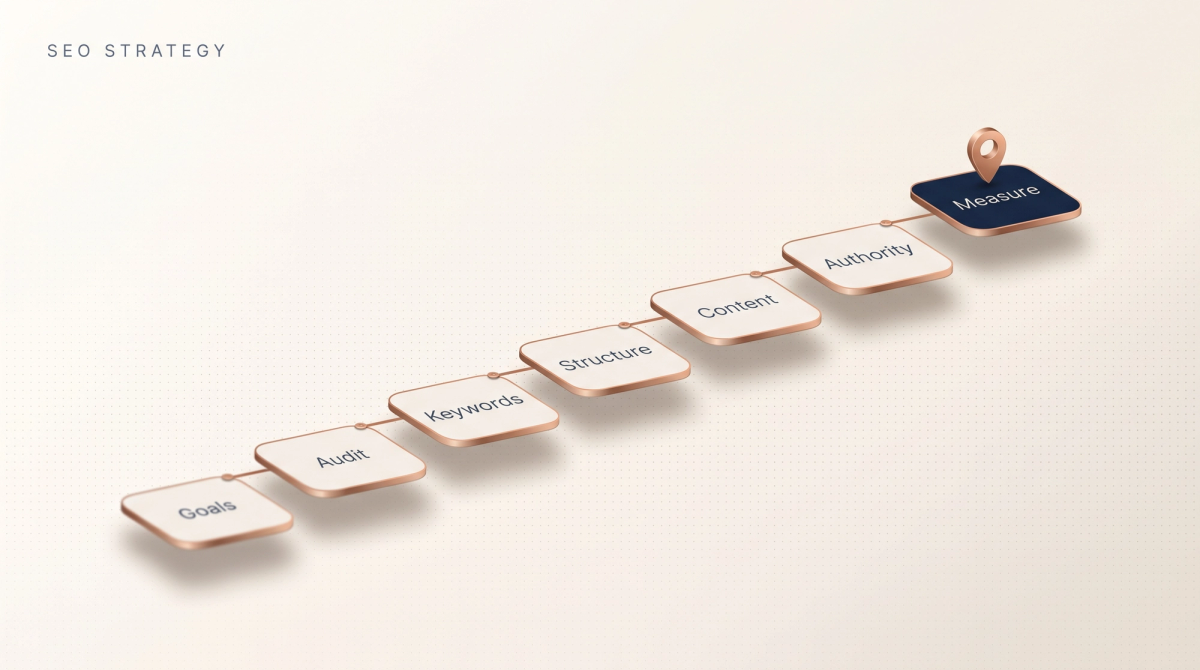
An SEO strategy is the difference between "we do SEO" and "we know why we build which page". Most companies have a to-do list: optimize meta titles, write blog posts, collect backlinks. What is missing is the decision which search queries actually bring revenue, which pages are missing for them and in which order they get built. Without that decision, SEO is a hobby with a budget.
We develop SEO strategies for B2B companies that take their website seriously as a sales channel, and we see the same finding in almost every audit: lots of activity, no priority. This article shows what separates an SEO strategy from a to-do list, how to develop one in seven steps, why AI search belongs in it from the start, what time and budget realistically cost, which mistakes make the plan fail and what a roadmap looks like that your team actually executes.
Key takeaways
- An SEO strategy answers three questions: which search queries bring revenue, which pages are missing for them, in which order do we build them. A to-do list answers none of them.
- Seven steps: goals and KPIs, status analysis, keyword and intent mapping, site architecture, content plan, technology and authority, measurement and iteration.
- GEO belongs in from the start: pages Google should rank must also be citable for ChatGPT, Perplexity and AI Overviews. That is the same structure, not a second project.
- Realistic horizon: first measurable movement after 3 to 4 months, reliable results after 6 to 12. At INSYNC, audit plus roadmap costs from 1,500 €, ongoing execution from 1,290 € per month.
- The three killers of any strategy: a keyword-stuffing plan instead of topics, no owner with time, and 40 equally important measures without order.
What is an SEO strategy, and what separates it from a to-do list?
An SEO strategy is a plan that connects business goals with search demand and derives from that which pages are built, reworked or deleted in which order. It answers three questions: which search queries bring us customers, not just visitors? Which pages do we need to be the best answer for those queries? And where do we start because it has the biggest leverage at the smallest effort?
A to-do list answers none of these questions. It says "optimize meta descriptions", "two blog posts per month", "build backlinks". Those are activities, not decisions. The difference becomes visible when resources get scarce: with a strategy you know which of the 40 items to cut. With a list you cut randomly or not at all and spend a year working on things that move no ranking.
The number that proves the difference comes from an Ahrefs analysis of several billion pages: around 96 % of all pages on the web get not a single visitor from Google. Not because they are badly written, but because nobody asked beforehand whether anyone searches for it and whether the page stands a chance against the top 10. Exactly that upfront question is strategy.
How do you develop an SEO strategy in 7 steps?
An SEO strategy emerges in seven steps, and the order is not negotiable: whoever starts with keywords before the goals are clear optimizes for traffic instead of revenue. Whoever plans content before the technology is checked writes articles for a site Google only half indexes. The steps below are the framework we work with in SEO consulting, from the first goal definition to the roadmap the team executes.
Three things upfront. First: steps 1 and 2 are a workshop plus an audit, together one to two weeks. Whoever cuts corners here pays later. Second: steps 3 to 5 are the actual strategy work. This is where the decisions emerge that steer everything else. Third: steps 6 and 7 run permanently. An SEO strategy is not a document finished in January but a plan sharpened quarterly.
Define goals and KPIs
What should SEO deliver in 12 months: inquiries, demos, applications, revenue? From that the KPIs: qualified leads from organic traffic, rankings for 10 to 20 money keywords, visibility in AI answers. Rankings alone are not a goal.
Status analysis and audit
Technology (indexing, Core Web Vitals, structure), content (which pages rank, which do not, why), authority (backlinks, mentions), competition (who ranks for our topics, with which pages). Result: an honest list of gaps.
Keyword and intent mapping
Collect search queries, sort by intent (informational, commercial, transactional) and assign each query a page: existing, to be reworked or new. Topic clusters instead of single keywords.
Site architecture and clusters
Service pages as money pages, knowledge articles as supporters, internal links in both directions. Each cluster has one main page and three to eight articles pointing to it.
Content plan with priority
Per page: keyword, intent, format, length, owner, date. Order by leverage: first pages sitting at position 5 to 15, then gaps with high revenue relevance, then reach.
Technology and authority
Fix technical errors from the audit, secure load time, set structured data. In parallel build authority: mentions, expert articles, partners, directories, press. Not bought, earned.
Measurement and iteration
Monthly: rankings, clicks, leads per page, AI mentions. Quarterly: what worked, what did not, what do we change in the plan. The roadmap lives.
What does keyword and intent mapping look like in practice?
Keyword mapping means assigning exactly one page to every relevant search query, and intent mapping means checking beforehand what the searcher actually wants with that query. Whoever searches "seo agency" wants to compare providers. Whoever searches "develop seo strategy" wants to learn and maybe get help later. Sending both queries to the same page loses both.
In practice it runs like this: we collect all search queries around the business, from tools like Ahrefs, from Search Console, from sales conversations and from the questions customers ask in the first call. Then we sort by intent and group into topics. A topic like "website costs" has one main query and 20 variants, and they belong on one page, not on 20. How to find and evaluate the queries is explained step by step in the article on keyword research.
The most important filter is the reality check against the top 10. For every query we look at who ranks: if only Wikipedia, Amazon and three DAX corporations sit there, the query is no priority for a mid-sized company, no matter how high the search volume. If thin agency pages with 400 words sit there, it is an opportunity. This check decides the order in the plan, not the search volume.
Why do GEO and AI search belong in the SEO strategy from the start?
GEO, the optimization for generative search engines like ChatGPT, Perplexity, Gemini and Google's AI Overviews, belongs in the SEO strategy from the start because the same pages serve both systems. A page that answers a question clearly in the first sentence, has clean subheadings, cites numbers with sources and carries structured data ranks on Google and gets cited by AI systems. Whoever plans GEO as a second project after the SEO strategy builds the pages twice.
What changes is the measurement and part of the prioritization. For AI answers it matters less whether you sit at position 3 but whether your page is named as a source when someone asks "best web design agency for industrial companies". That means: pages with clear definitions, comparisons, price ranges and lists get more weight in the plan because they are citable. And mentions on other sites, in directories, press and expert articles, become more important because AI systems learn from them who is relevant in an industry.
The complete difference between the two disciplines and what concretely changes in the strategy is explained in the article SEO vs. GEO. For the roadmap it means in practice: one more KPI (visibility in AI answers for 10 to 20 core questions), one more content rule (answer in the first sentence, cite the source) and one more block of measures (build mentions). No second project.
How long does an SEO strategy take, and what does it cost?
Developing an SEO strategy takes two to four weeks, its execution shows first measurable movement after three to four months and reliable results after six to twelve. Whoever gets faster promises should ask how. Google needs time to crawl, evaluate and rank new pages against the competition, and authority does not emerge in weeks.
On budget. In the market, ongoing SEO support sits between 700 and 3,000 € per month according to our observation, strategy workshops and audits between 1,000 and 5,000 €. Those are market ranges for orientation, not INSYNC prices. With us the strategy as a package of audit and roadmap costs from 1,500 €, a strategy workshop from 1,200 €. Execution runs as SEO support in a retainer: Care from 1,290 € per month for maintenance and monitoring, Growth from 1,790 € per month plus 3,900 € setup with ongoing content production, Growth Max from 3,390 € per month plus 4,900 € setup for teams running SEO and GEO as their main channel. An honest classification of all price tiers is in the article What does SEO cost.
The question that comes before the budget: who executes? A strategy that plans 30 pages and 12 articles needs someone to write them, someone to build them and someone to approve them. If nobody internally has the time, the retainer is not a luxury but the precondition for the plan to become anything.
Time horizon of an SEO strategy
| Phase | Period | What happens | What you see |
|---|---|---|---|
| Strategy | Week 1 to 4 | Workshop, audit, mapping, roadmap | A prioritized plan with owners and dates |
| Foundation | Month 1 to 3 | Technical fixes, rework money pages, first clusters | Clean indexing, first movement at position 5 to 15 |
| Build-up | Month 3 to 6 | Fill content clusters, internal links, mentions | Rankings for core keywords, first leads, first AI citations |
| Scaling | Month 6 to 12 | More clusters, re-optimization, authority | Reliable lead flow, plan sharpened quarterly |
Which mistakes make an SEO strategy fail?
Most SEO strategies fail not at the analysis but at three mistakes in execution. The first is the keyword-stuffing plan: a spreadsheet with 300 keywords and the intention to build a page for each. That produces 300 thin pages cannibalizing each other instead of 15 strong pages each covering one topic. Google has been evaluating topics, not single terms, for years. The right unit in the plan is the cluster, not the keyword.
The second mistake is the missing owner. The strategy sits as a PDF on the drive, marketing likes it, the managing director too, and nobody has four hours per week for it. After three months two of twelve articles are done and the technical fixes wait for the agency that built the website. A strategy without a name and hours next to every measure is a wish. The third mistake is missing prioritization: 40 measures, all "important", no order. The team starts with the easiest ones, usually meta descriptions, and the pages that would actually bring revenue never get their turn.
Then there are the silent mistakes: ignoring technology because content is more exciting, although the site loads in three seconds and half the URLs are not indexed. What to check there is in the article on technical SEO. Measuring rankings as the only goal, although position 1 for a keyword without buying intent delivers nothing. And never touching the strategy again after launch, although competition, search behaviour and since 2025 the search interface itself keep changing.
How is an SEO roadmap structured that the team actually executes?
An SEO roadmap that gets executed has six columns and fits on one page: measure, target keyword or cluster, expected leverage (high, medium, low), effort in hours, owner, date. Sorted by leverage divided by effort. Anything that cannot be expressed in this format is not a measure but an idea, and ideas belong in a separate backlog.
The structure in practice: block 1 is quick wins, pages at position 5 to 15 with revenue relevance that can reach the top 5 with a rework, plus technical errors blocking indexing or load time. Block 2 is the money pages: service pages that are missing or too thin. Block 3 is the cluster articles pointing to the money pages, three to eight per topic. Block 4 is authority: mentions, expert articles, directories. Block 5 is measurement: which numbers are checked when and who sharpens the roadmap each quarter.
What is not in the roadmap: search volume as a sorting criterion, rankings as the only KPI and measures without names. What is in it: for every page the question it answers and the sentence it starts with. That sounds petty but it is the difference between a page Google and ChatGPT recognize as an answer and one that merely exists. How to concretely improve existing pages from this roadmap is shown in the article Improve Google ranking. And if you first want to know where the site stands today before the plan, an SEO audit is the first step.
When is SEO consulting worth it for the strategy?
SEO consulting for the strategy is worth it when the time or experience to realistically assess the top 10 is missing internally, and when the website as a sales channel should deliver more than a few inquiries per year. The value lies not in the document but in the decisions: which 15 pages first, which 200 keywords never, which technical fixes before the first article.
With us it runs as a package of audit and roadmap: a workshop on goals and target groups, an audit across technology, content and authority, the keyword and intent mapping including GEO questions, and at the end the roadmap in the format described above, with owner proposal and order. After that you decide whether your team executes or we do. In SEO consulting that is calculated from 1,500 €, with one clear rule: if we see in the audit that SEO is not the right channel for your business, we say so instead of selling a retainer.
Frequently asked questions
An SEO strategy includes goals and KPIs, a status analysis of technology, content and authority, a keyword and intent mapping with page assignment, a site architecture with clusters, a prioritized content plan with owners and dates, a block for technology and authority, and a measurement concept with quarterly review. GEO criteria for AI search belong in each of these points since 2025.
First measurable movement usually shows after three to four months, reliable results like stable rankings and regular leads after six to twelve months. It goes faster for pages already at position 5 to 15 that get reworked. It goes slower in markets with strong competitors and for websites without existing authority.
At INSYNC the SEO strategy as a package of audit and roadmap costs from 1,500 €, a strategy workshop from 1,200 €. Ongoing execution in a retainer starts at 1,290 € per month. In the market, audits and strategy workshops sit between 1,000 and 5,000 € according to our observation, ongoing support between 700 and 3,000 € per month.
The SEO strategy decides which search queries bring revenue, which pages get built for them and in which order. SEO measures are the individual activities that follow: rework a page, write an article, improve load time, build a mention. Measures without strategy are activity without priority, strategy without measures is a PDF.
Yes, if you have access to Search Console and a keyword tool, can honestly assess the top 10 for your topics and have four to eight hours per week free for execution. The seven steps in this article are the framework for it. It usually gets difficult at the reality check against the competition and at prioritization, and that is where an external view helps most.
No, you need an SEO strategy that considers GEO from the start. The same pages serve Google and AI systems like ChatGPT or Perplexity if they answer questions in the first sentence, cite numbers with sources and carry structured data. What is added is a KPI for visibility in AI answers and a block of measures for mentions on other sites.
The metrics monthly, the roadmap quarterly, the strategy itself once a year. Monthly you check rankings, clicks, leads per page and AI mentions. Quarterly you decide which measures worked and what moves forward in the order. Annually you check whether goals, target groups and topics still fit the business.
SEO consulting
Audit plus roadmap from 1,500 €: goals, status analysis, keyword and intent mapping, prioritized plan with owners and dates.
SEO audit
What an audit checks, which tools you need and how to turn findings into a priority list.
Keyword research
Find search queries, sort by intent and evaluate realistically against the top 10.