



SEO audit: what is checked, process, and costs
What an SEO audit really checks, how it runs, which tools are behind it, what it costs, and the checklist for doing it yourself. Including AI readability, which belongs in 2026.
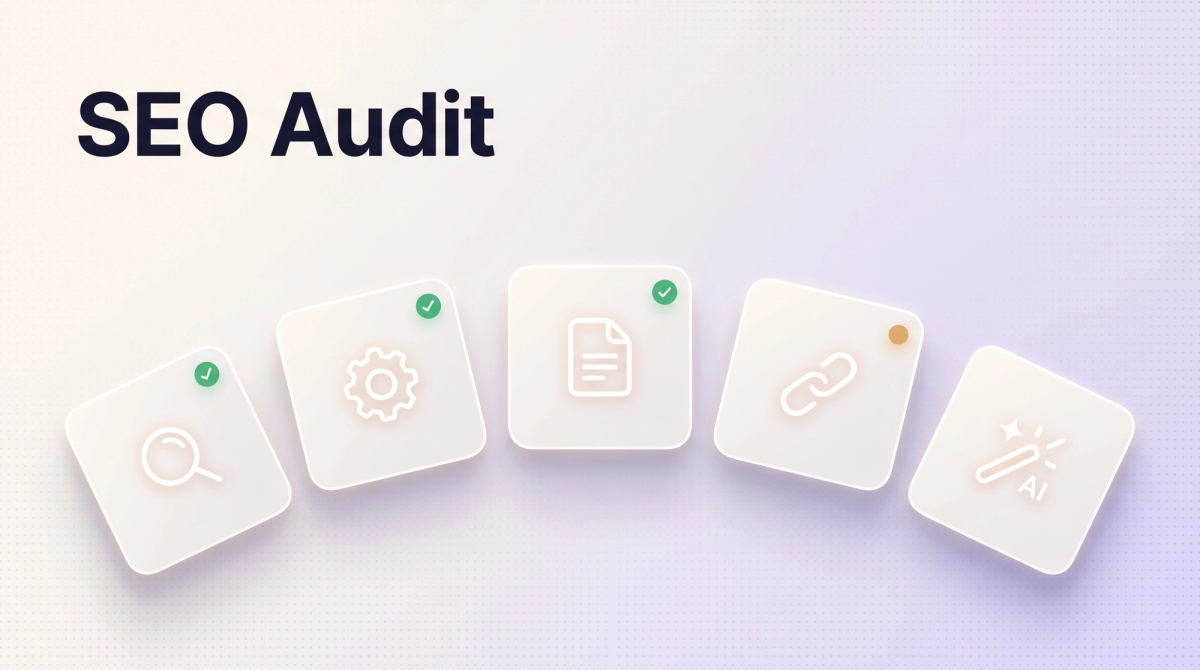
An SEO audit is the systematic inventory of your website: technology, content, authority, and since 2026 also the question of whether AI systems can read and cite your site at all. What comes out at the end is not an error report but a prioritized list of what has to happen first and why.
Most companies know their website ranks poorly. They just do not know why. That is exactly the gap an audit closes. This article shows you what a good audit checks, how it runs, which tools we use, what it costs in the market and with us, and which checklist lets you run a first check yourself.
Key takeaways
- An SEO audit checks five areas: technology, on-page, content, authority (backlinks), and since 2026 the AI readability of your site.
- The result is a prioritized roadmap, not an 80-page error list. Whoever only gets a tool export did not get an audit.
- Market prices according to Ahrefs (2026): 1,000 to 5,000 euros depending on size. With us: audit plus roadmap from 1,500 euros.
- An audit takes 5 to 10 working days. Technical fixes take effect after 4 to 8 weeks, content and authority after 3 to 6 months.
- Useful before every relaunch, after a traffic drop, or when you have spent SEO budget for 6 months without seeing movement.
What is an SEO audit?
An SEO audit is a complete analysis of your website with the goal of finding the causes of missing visibility and deriving concrete, prioritized actions from it. It answers three questions: Can Google find and understand your pages? Is the content the right one for your customers’ search queries? And does Google trust you enough to put you ahead of the competition?
The difference from quick consulting: an audit works without assumptions. First the inventory, then the recommendation. And the difference from a tool report: a tool tells you that 340 images have no alt text. An audit tells you that this does not matter as long as your most important service page is set to noindex.
That classification is exactly the value. We regularly see competitor audits that run 60 pages and still do not answer the question of what to do first.
What is checked in an SEO audit?
A complete SEO audit covers five areas: technology, on-page, content, authority, and AI readability. The first four are standard; the fifth is still missing from most audits in 2026, even though a growing share of research happens in ChatGPT, Perplexity, and Google AI Mode.
Technology: can Google crawl your site?
The technical part checks whether Google finds, indexes, and can quickly load all relevant pages. This includes crawling and indexing (robots.txt, sitemap, noindex errors, redirect chains), Core Web Vitals and load time, mobile rendering, HTTPS, canonical tags, duplicate content, and structured data. Sounds dry, but it is the area with the fastest effects: a wrongly set noindex or a 5-second load time blocks everything else. More in the article on technical SEO.
On-page: are titles, structure, and linking clean?
This is about every single page: title tags and meta descriptions (unique, with keyword, in the right length), heading hierarchy, internal linking, images, and URL structure. Typical findings: 40 pages with an identical title, important pages without a single internal link, H1 without keyword. All things that can be fixed in a few days and still move rankings. The details are in the article on on-page SEO.
Content: do you serve the right search queries?
The content part compares your content with what your target group actually searches for. It checks keyword coverage and cannibalization (two pages fighting for the same keyword), search intent (informational vs. commercial), thin or outdated pages, and content gaps versus competitors. This is usually where the biggest lever for B2B sites sits: the service pages exist, but nobody answers the questions customers ask before buying.
Authority: who links to you?
The backlink profile shows how many domains refer to you, how relevant they are, and whether toxic links are among them. Plus the competitor comparison: which sources link to three competitors but not to you? That is the list link building starts with later. How to proceed afterwards is in building backlinks.
AI readability: can ChatGPT and co. cite you?
The new fifth area checks whether AI systems can retrieve, understand, and cite your content as a source. Concretely: does your robots.txt block GPTBot, ClaudeBot, or PerplexityBot? Is content built in clear question-and-answer structures? Are there structured data, an llms.txt, direct answers in the first paragraph? And: are you mentioned at all in AI answers on your core topics, or only your competitors? We include this in every audit, because it is visibility no ranking tool shows.
How does an SEO audit run?
An SEO audit runs in four phases and takes 5 to 10 working days with us: briefing, analysis, report, presentation. You mainly need one thing for it: read access to Google Search Console. Everything else we pull from tools and the crawl.
Briefing. Goals, competitors, previous measures, access (Search Console, Analytics, CMS insight). One meeting, 45 minutes.
Analysis. Crawl of the entire website, evaluation of the last 16 months of Search Console data, backlink profile, competitor comparison, manual review of the 20 to 30 most important pages, AI mention check. This is the part no tool does alone, because tools count symptoms and do not recognize causes.
Report. Every finding with explanation, impact, and a concrete action. Prioritized by leverage and effort: what blocks, what brings quick results, what is optional. With us, this ends in a roadmap for the next 6 months.
Presentation. A call in which we go through the findings and clarify questions. An audit without explanation is worth half.
Which tools does an SEO audit need?
A professional audit combines four to five tools, because no single one covers all areas. Google Search Console and PageSpeed Insights are free and deliver the real Google data. Screaming Frog crawls the website like a search engine bot (free up to 500 URLs). Ahrefs or Semrush deliver keywords, backlinks, and the competitor comparison, from around 100 euros a month.
For AI readability, Ahrefs Brand Radar is added, which tracks mentions in ChatGPT, Perplexity, and Google AI Overviews, plus manual spot checks in the AI systems themselves. Internally, we work with Ahrefs at the core and our own scripts for the points no tool checks cleanly, such as rendering problems on JavaScript sites or the consistency of structured data.
Important: the tool does not do the audit. A Screaming Frog export with 2,000 rows is raw material. The audit is the decision about which 12 of them count.
What does an SEO audit cost?
A professional SEO audit costs 1,000 to 5,000 euros in the German market, according to the Ahrefs market overview (July 2026). Small websites up to 30 pages are often at 400 to 900 euros with providers like SEO freelancers, mid-size websites up to 150 pages at 800 to 2,000 euros, large or technically complex setups at 2,000 to 5,000 euros and more.
With us, an SEO audit including roadmap costs from 1,500 euros. Included are all five review areas, the manual review of the most important pages, the competitor comparison, the prioritized 6-month roadmap, and the presentation call. Whoever moves into execution with us after the audit gets the audit credited against the setup of our SEO support.
Be careful with audits below 300 euros or "free SEO checks". In almost all cases these are automated tool reports with a new cover page: an error list, but no findings and no prioritization. They are not worthless, but they do not answer the question of why you do not rank. If you want to buy a real audit instead, the selection criteria and a provider overview are in best SEO agency, including what happens to your accounts after the contract ends.
Check indexing
Enter "site:your-domain.com" in Google and compare the number with your page count. Check in Search Console under "Pages" which URLs are excluded and why.
Measure load time and Core Web Vitals
PageSpeed Insights for the homepage and the three most important service pages. Mobile values count. Anything below 50 points is a blocker.
Check titles and meta descriptions
Run a Screaming Frog crawl, filter for duplicate and missing titles. Every important page needs a unique title with the keyword up front.
Match rankings with goals
Search Console, Performance, last 3 months: which queries are you shown for? If your most important service keywords are completely missing, you have a content problem, not a technical one.
Check internal linking
Does every service page have at least 3 internal links from body copy? Pages linked only in the footer are treated as unimportant by Google.
Compare backlinks with competitors
Ahrefs or Semrush: number of referring domains for you vs. three competitors. If you sit at one tenth, that often explains the ranking gap on its own.
Check AI access and AI mentions
Check robots.txt for GPTBot, ClaudeBot, PerplexityBot. Then ask five typical customer questions in ChatGPT and Perplexity: are you mentioned? Who is mentioned instead?
When is an SEO audit worth it?
An SEO audit is worth it in four situations: before a relaunch, after a traffic drop, with a stagnating SEO budget, and when taking over a website whose history you do not know.
Before the relaunch it is mandatory. Whoever does not know the old site cannot carry the rankings into the new one. We have seen relaunches where 70 percent of organic traffic was lost because nobody checked beforehand which 15 URLs bring the traffic. After a drop, the audit is the diagnosis: Google update, technical error, or a competitor that overtook you.
And if you have spent SEO budget for 6 months and nothing happens, an independent audit tells you whether the problem lies in execution, strategy, or the market. For brand-new websites, a full audit is too early: without Search Console data the basis is missing. Here, SEO consulting during the concept phase makes more sense, and the audit comes 4 to 6 months after launch. How the audit results then turn into an SEO strategy with a roadmap, we describe in seven steps.
Frequently asked questions
An SEO audit is the systematic analysis of a website for technical errors, content weaknesses, missing authority, and since 2026 for AI readability. The goal is a prioritized list of concrete actions that improve organic ranking. It is the first step before any serious optimization, not a replacement for it.
A professional SEO audit costs 1,000 to 5,000 euros in the German market, depending on the size and complexity of the website. Small websites up to 30 pages start at 400 euros, large shops sit at 5,000 euros and more. With us, an audit including a 6-month roadmap costs from 1,500 euros.
An SEO audit takes 5 to 10 working days, for very large websites up to three weeks. The crawl itself is done in hours; the time goes into manual review, competitor comparison, and prioritization. You see the first effects of technical fixes 4 to 8 weeks after implementation.
A basic check, yes: Search Console, PageSpeed Insights, and Screaming Frog (free up to 500 URLs) are enough for indexing, load time, and title errors. What you struggle to get yourself is the classification: which of the 200 errors really blocks, and how does your site stand against the three competitors ranking ahead of you.
At minimum, read access to Google Search Console. Google Analytics and a look into the CMS for technical checks are helpful. No reputable provider needs admin passwords or access to sensitive systems for an audit.
The audit is the one-off inventory with an action plan. Support is the ongoing execution, measurement, and adjustment in a monthly model. The audit says what to do, support does it. With us, the audit is therefore the typical entry into support and is credited against the setup.
A full audit every 12 to 18 months, plus a short technical check after every major website update. Whoever is in ongoing support does not need a separate audit, because technology, rankings, and AI mentions are monitored there monthly.
Technical SEO
Crawling, indexing, load time: the foundation.
On-page SEO
Title, structure, and linking per page.
SEO consulting
Audit plus roadmap from 1,500 euros, workshop from 1,200 euros.
Migrating WordPress to Next.js
Six phases, costs and how rankings hold up along the way.
Getting 301 redirects right
Status codes, redirect map and the mistakes that cost rankings.