


Website for industrial companies: what buyers and engineers expect in 2026
Why industrial websites often look like 2010, what buyers and engineers really look for, catalog or configurator, hreflang, lead routing, trade fair integration, costs and process.
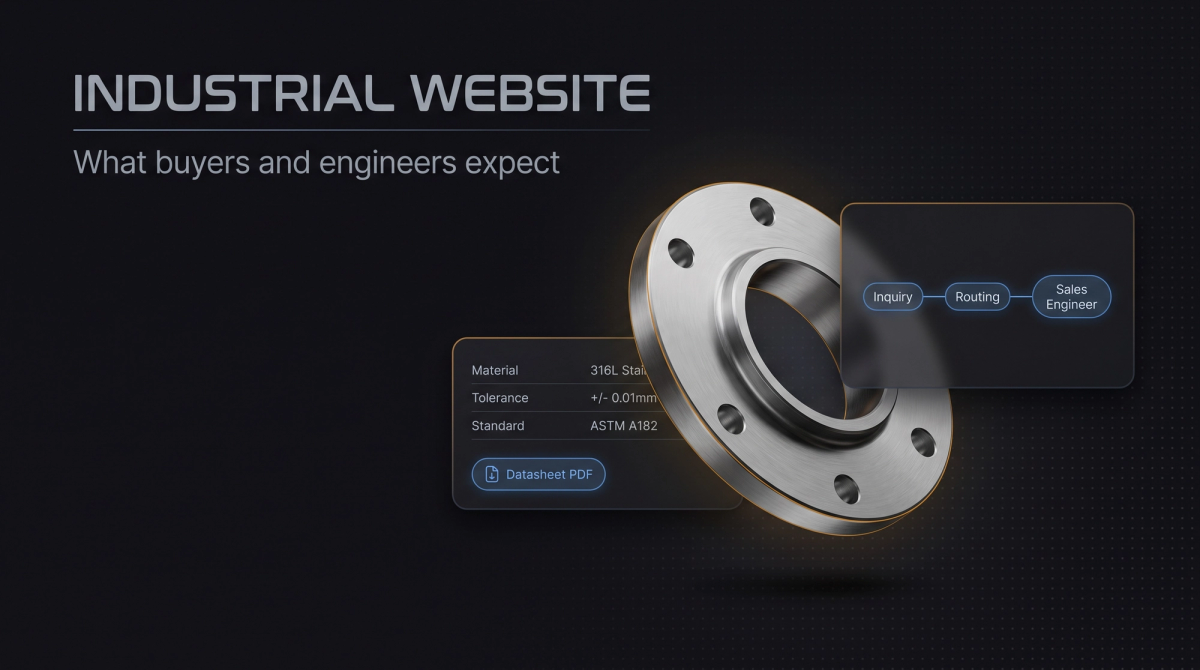
A website for industrial companies has a harder job than almost any other B2B site: it must convince a buyer comparing ten suppliers and an engineer looking for a datasheet, both without anyone from sales sitting next to them. Most mechanical engineering and manufacturing websites manage neither. They look like 2010, hide the products behind three clicks and end with "contact us".
We build websites for industry and mid-sized companies, and this article sums up what an industrial website needs to deliver in 2026: what buyers and engineers really look for, when a product catalog is enough and when a configurator makes sense, how multilingual setups run cleanly on the technical side, how inquiries reach the right contact person, what trade fairs have to do with it, what it all costs and how a project runs.
Key takeaways
- Buyers and engineers research long before first contact. According to the Demand Gen Report 2025, 67 % of B2B buyers start their supplier search online.
- Four things are searched for: technical product data, downloads (datasheets, CAD, certificates), verifiable references and a concrete contact person.
- A product catalog is enough for standard products, a configurator only pays off with many variants and frequent sales queries.
- Multilingual setups need clean hreflang tags, real translation and separate contact persons per market, otherwise they cost rankings instead of bringing them.
- Costs: market range 5,000 to 20,000 €, at INSYNC in the premium package 15,000 to 30,000 €+ with 6 to 12 weeks duration, including product structure, multilingual setup and lead routing.
Why do industrial websites so often look like 2010?
Industrial websites look like 2010 because they were built in 2010 and only content has been added since. That is not an accusation but an observation from almost every first conversation: the company invested in machinery, certifications and skilled staff, the website was never a management priority because orders came through existing customers and trade fairs.
That is exactly what is changing right now. The generational shift in purchasing is done. The buyer looking for a supplier today is in their mid-30s, compares on screen and infers the processes behind a website from 2010. According to the Demand Gen Report 2025, 67 % of B2B buyers begin their supplier search with online research before taking any sales contact. Whoever does not show up or looks weak in this phase is off the longlist before sales even knows there was a tender.
Then there is recruiting. A 28-year-old design engineer looks at the website before applying, and a stock photo of a man in a helmet tells him more about the company than any sentence in the job profile. The website is thus both a sales and an employer tool, and both roles fail at the same problem: it does not show the substance that actually exists in the company.
What do buyers and engineers really look for on an industrial website?
Buyers and engineers look for four things on an industrial website: technical product data, downloads, references and a contact person. In that order, and all within two clicks. Everything in front of it (slider, image film, "welcome to") is ballast for them.
The engineer wants numbers: dimensions, tolerances, materials, performance data, standards. They want the datasheet as PDF, the CAD file in the right format and the certificates (ISO 9001, ISO 14001, industry-specific approvals) without a registration form. Every hurdle in front of a download costs you a design engineer who would otherwise have taken your part into their drawing. The buyer wants proof: whom have you built this for, in what quantity, with what result. A logo wall proves nothing, a project description with starting point, solution and metric does.
And both want a human. Not "info@", but the sales engineer for their region or industry with name, photo, direct line and email. In mechanical engineering that is not a detail but the difference between an inquiry that comes and one that lands with the competitor. We build exactly these four elements into every project for web design for industry and mechanical engineering before design is even discussed.
What the target groups of an industrial website look for
| Target group | Looks for first | What the site must deliver |
|---|---|---|
| Buyer | Delivery capability, references, certificates, location | Industry and reference pages, certificates as download, clear inquiry |
| Design engineer, engineer | Technical data, datasheets, CAD, standards | Product pages with tables, downloads without form, filters |
| Management | Size, history, capacity, stability | Company page with real numbers, team, locations |
| Applicant | Work environment, machinery, culture, open positions | Career page with real photos and concrete positions |
Product catalog or configurator: what does your website need?
A product catalog is enough if your products exist in variants with fixed properties. A configurator pays off if customers assemble products from parameters and your sales team answers the same questions ten times a day. The decision does not depend on what looks more modern but on where time gets lost in sales.
The catalog is mandatory. Every product gets its own page with description, technical table, images, downloads, applications and the responsible contact person. Add filters by the criteria engineers really search by (frame size, material, performance range, standard), not by your internal product families. It must be maintainable via a CMS or PIM integration so a new product is online in an hour and does not end up in an agency ticket.
The configurator is the extra. It pays off from the point where customers assemble their part from length, diameter, material and connection themselves and can send an inquiry with all parameters directly. That saves your sales team the pre-qualification and gives the customer an immediate result. But: a configurator without clean product data is an expensive form. First the data, then the tool.
Multilingual and international: how does it run cleanly on the technical side?
A multilingual industrial website needs three things: its own URL per language, hreflang tags on every page and content that has actually been translated and not just run through a machine. Whoever does that cleanly ranks in every target market. Whoever does it halfway loses rankings in both languages because Google reads the versions as duplicates.
The URL structure decides early: subdirectories like /en/ or /fr/ are the best choice for most mid-sized companies because they carry the authority of the main domain. Per page and language there must be a hreflang reference to all other language versions including its own and an x-default. Sounds technical, but it is the point someone forgot in almost every relaunch audit. Just as important: the English site needs English titles, meta descriptions, alt texts and datasheets, not just translated body copy.
And then the question nobody asks: who answers the inquiry from France? A French page without a French-speaking contact person and without information on delivery and customs produces inquiries that sit untouched in sales. Multilingual is a sales decision with a technical implementation, not the other way round. For a relaunch there is one more rule: all old URLs per language must be redirected cleanly, otherwise you lose the rankings you built over years. How that works is in our article on the website relaunch.
Lead routing: how does the inquiry reach the right contact person?
Lead routing means: an inquiry via the website automatically lands with the person who can answer it, with all the information they need. On most industrial websites it lands in a shared inbox instead, gets forwarded after two days and answered after four. By then the buyer has two other quotes.
The implementation is unspectacular but effective. The inquiry form asks for product area, application, region and quantity or project size. From these fields a rule decides who gets the inquiry: sales engineer south, key account automotive, service. The inquiry goes into the CRM (HubSpot, Salesforce, Pipedrive or whatever you use) and in parallel as an email with all fields to the responsible person. The customer gets a confirmation with name and photo of their contact person and a realistic response time.
Two things make the difference between a form and lead routing: on every product and industry page the matching contact person sits right next to it, and datasheet downloads are tied to an optional, not forced, company field. That way your sales team knows which company is currently interested in which product before the inquiry even arrives. What that means for forms, buttons and page structure is in our article on conversion optimization.
Trade fair and website: how do both work together?
The trade fair is still the most important sales channel in mechanical engineering, and the website is what the visitor opens after the fair. Thinking both together costs little and brings a lot. Most companies still treat them as two worlds: booth builder here, agency there.
Concretely, trade fair integration means: for every fair there is a dedicated landing page with hall, booth, exhibits, appointment booking for booth meetings and the contact persons on site. QR codes on the booth and on flyers lead directly to product pages with downloads, not to the homepage. After the fair the page becomes the follow-up page: presentations, datasheets of the shown novelties, a form for "we spoke at the fair". After the conversation, sales does not send a PDF attachment but a link to exactly this page, and sees in the CRM who opened it.
The side effect is SEO: trade fair names plus product category are search terms with small volume and very high purchase intent, and a maintained fair page ranks for them almost without competition. That applies all the more if your website as a whole is cleanly built as a corporate presence. What belongs to that is described in our article on the corporate website.
What does a website for industrial companies cost?
A professional industrial website costs between 5,000 and 20,000 € on the market, considerably more for multilingual sites with product catalog, configurator and CRM integration. At INSYNC an industrial website in the premium package sits at 15,000 to 30,000 €+, with 6 to 12 weeks duration.
What drives the price is the scope, not the design: number of product and industry pages, whether a catalog is connected from PIM or ERP, whether a configurator is built, how many languages, whether photos and videos from production need to be produced, whether lead routing and CRM are integrated. A family business with 30 products and two languages sits at the lower end. A plant manufacturer with 400 products, five languages, configurator and Salesforce integration at the upper end.
What matters is the counter-calculation. A single order from a qualified website inquiry in mechanical engineering is often in the five- or six-figure range. So the website does not have to bring a hundred inquiries but the right three per year. We build on Next.js or Astro with Sanity as CMS for that, Webflow is possible as an option, so your team maintains products, positions and trade fairs itself. A detailed classification of the price tiers is in our article on what a B2B website costs.
Costs of an industrial website by scope
| Scope | Market range | INSYNC |
|---|---|---|
| Corporate site, 10 to 20 pages, 1 to 2 languages, references | 5,000 to 12,000 € | Business package 8,000 to 15,000 €, 4 to 8 weeks |
| Plus product catalog with filters and downloads, lead routing, 2 to 3 languages | 12,000 to 25,000 € | Premium package from 15,000 €, 6 to 12 weeks |
| Plus configurator, PIM or ERP integration, CRM integration, 4+ languages | 25,000 to 60,000 € | Premium package 30,000 €+, individually quoted |
The most common mistakes on industrial websites
The mistakes on industrial websites repeat so reliably that we can list them before the first look at the site. The first: the homepage talks about the company instead of the customer. "Precision with passion since 1962" does not answer whether you can deliver a part in this tolerance in this quantity by October.
The second: products without data. A product page with three paragraphs of text and one image but no technical table is worthless to an engineer. The third: downloads behind forms. Every mandatory field in front of a datasheet halves the downloads, and the design engineer takes the competitor's datasheet that is freely available. The fourth: stock photos. The man with helmet and clipboard stands on a thousand industrial websites, and every decision-maker recognizes him. Your hall, your machinery and your people are the strongest imagery you have.
Then the technical mistakes: load times over three seconds due to uncompressed machinery photos, no mobile version (buyers read on their phones in the evening too), language versions without hreflang, a contact form without routing. And finally the strategic mistake: no clear next step. Every page needs an action: download datasheet, call contact person, send inquiry, book trade fair appointment. Whoever leaves that to chance gets random inquiries.
How does a website project for industrial companies run?
A website project for an industrial company runs in six phases, and the first two decide its success: analysis and structure. Projects that fail or take twice as long have almost always skipped these two phases and started directly with design.
In the analysis we talk to sales, engineering and management, not just marketing. We want to know which inquiries come in, which questions sales answers constantly, which products bring margin and which trade fairs matter. From that the page structure emerges with product, industry and reference pages, the lead routing concept and the language plan. Only then come copy, design and development. The handover does not end with the launch but with a training session so your team maintains products, fairs and positions itself. That is exactly how every project for web design for industry and mechanical engineering runs with us. If you are evaluating other firms in parallel, best agency for industrial websites sorts the market by product data, multilingual setup and lead routing.
Analysis with sales and engineering
Which inquiries come in, which questions annoy, which products and markets matter. Result: target groups, priorities, language plan.
Structure and product data
Page tree with product, industry, reference and trade fair pages. Clean product data from PIM, ERP or Excel, define filter criteria.
Copy and imagery
Copy from the perspective of buyer and engineer, photo shoot in hall and production, references with starting point, solution and metric.
Design
Clear, reduced design with own imagery. Product pages and tables are designed first, not the homepage.
Development and integration
CMS, catalog, downloads, hreflang, lead routing into CRM, performance, accessibility. All old URLs get redirected.
Launch, training, measurement
Go-live, Search Console, team training. Then check monthly: inquiries per product area, downloads, rankings per language.
Frequently asked questions
An industrial website must show products with technical data and downloads, present references verifiably, name a concrete contact person per area and route inquiries automatically to the right person. Add multilingual setup with hreflang, a career page with real photos and a load time under three seconds, on mobile too. Everything else is optional.
On the market, industrial websites sit between 5,000 and 20,000 €, with product catalog, configurator, several languages and CRM integration also at 25,000 to 60,000 €. At INSYNC an industrial website in the premium package costs 15,000 to 30,000 €+ and is live in 6 to 12 weeks, including product structure, multilingual setup and lead routing. A simple corporate site starts in the business package from 8,000 €.
Only if your products are assembled from parameters and your sales team regularly answers the same questions about variants. For standard products with fixed properties a catalog with good filters and datasheets is enough. A configurator without clean product data is an expensive form, so clean the data first, then build the tool.
No, at least not behind mandatory fields. Every hurdle in front of a download halves usage, and design engineers then take the competitor's freely available datasheet. Sensible is an optional field for company and email that sales uses as a signal without the download depending on it. Free access to technical data is a trust signal in mechanical engineering.
Very important as soon as you have or aim for international customers. A bilingual site (DE/EN) is standard in mechanical engineering. The clean implementation is decisive: own URLs per language, hreflang tags on every page, translated titles, meta descriptions and datasheets as well as an English-speaking contact person. Machine translation without review is not enough for that.
A cleanly planned project takes 6 to 12 weeks in the premium package at INSYNC, simpler corporate sites 4 to 8 weeks. What extends the schedule is almost always on the client side: missing product data, missing photos, many internal approval loops. Whoever provides product data and imagery before kickoff keeps the plan.
Web design for industry and mechanical engineering
Premium websites for industry and mid-sized companies: product structure, multilingual setup, lead routing.
What does a B2B website cost?
Price tiers, cost drivers and what a realistic budget includes.
Website relaunch
When a relaunch makes sense and how you keep your rankings while doing it.
WordPress alternatives compared
Site builders, Webflow, Framer and code with Sanity, with a clear recommendation.
TYPO3 alternatives in 2026
When a switch pays off, and where to go next.