


Startup website: MVP or brand website, costs and timing
When a startup needs an MVP website and when a brand website, what investors and first customers want to see, builder or agency, costs from 6,000 € and the right time for a relaunch.
In its first 18 months a startup website has three audiences who all open the same page and look for completely different things: first customers who want to know whether the product solves their problem, investors who check whether the team can deliver, and applicants who decide whether they want to work for you. Most founders build the site for none of the three, but for themselves.
We have built websites for startups before the seed round, after the first funding and in scale-up, and the question is almost always the same: how much website does the startup need now, and how much later? This article answers it: MVP website or brand website, what investors and first customers really want to see, speed to launch, builder or agency without sugarcoating, pitch deck consistency, waitlist and signup, SEO foundation from day one, scalability and the right moment for a relaunch after seed.
Key takeaways
- Before product-market fit an MVP website is enough: a one-pager with problem, solution, proof and one goal (waitlist, demo or signup). Everything else is premature.
- Investors google before the first call. The website has to match the pitch deck: same story, same numbers, same positioning.
- Speed to launch beats perfection: a professional one-pager goes live in 2 to 4 weeks, at INSYNC from 6,000 €.
- A builder is a legitimate choice before the first customer. From the moment the site has to convince customers and investors, it is the more expensive option.
- Scalable means: CMS and stack that survive the post-seed relaunch without a rebuild. Sanity plus Astro or Next.js carries from one-pager to 80-page site.
MVP website or brand website: what does a startup need when?
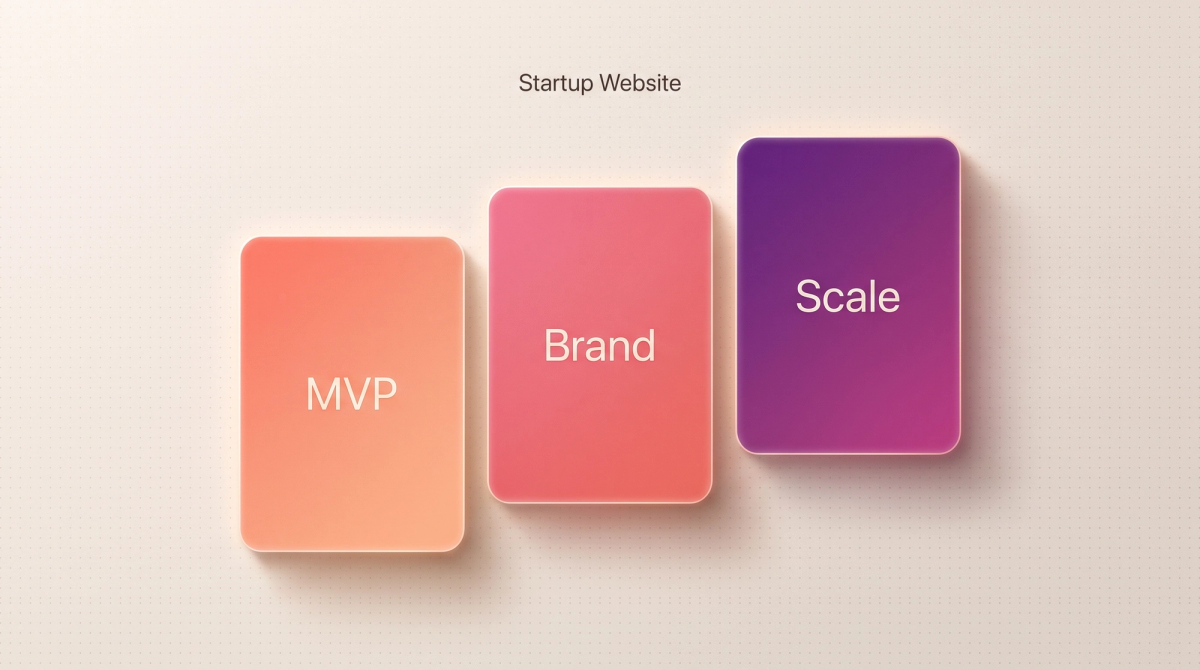
A startup needs an MVP website before product-market fit and a brand website after product-market fit. The MVP website is a one-pager that names a problem, shows a solution, delivers proof and has exactly one goal. The brand website is the complete presence with positioning, service or product pages, team, careers, press and knowledge. Whoever swaps the order burns money.
The typical mistake in the pre-seed phase: 15 subpages for a product that will have a different name in three months. Every page you build before product-market fit is a bet on a positioning you have not validated yet. The reverse mistake in the post-seed phase: a team of 20 people with 1.5 million € in the bank presents itself with a Notion template. For customers that is a signal the product might look the same.
The rule of thumb we give founders: as long as you are still changing the product in conversations with the first ten customers, the website stays a one-pager. As soon as you know whom you sell what to and the sales process repeats, it becomes a brand website. In web design for startups we clarify this phase first, because it determines scope and therefore budget and timeline.
MVP website and brand website compared
| Criterion | MVP website | Brand website |
|---|---|---|
| Phase | Pre-seed to seed, before product-market fit | Post-seed, repeatable sales process |
| Scope | One-pager, 5 to 7 sections | 10 to 30 pages, CMS, blog, careers |
| Goal | One goal: waitlist, demo or signup | Several routes: customers, investors, applicants |
| Duration | 2 to 4 weeks | 4 to 8 weeks, Premium 6 to 12 |
| Costs at INSYNC | 6,000 to 8,000 € | 8,000 to 15,000 €, Premium 15,000 to 30,000 € |
What do investors and first customers want to see on a startup website?
On a startup website investors want to see three things in 30 seconds: a clear problem with a clear market, a team they trust to build the solution, and traction, even if it is small. First customers want something else: does this solve my problem, what does it cost, and can I try it today. Both groups open the same homepage.
The solution is not compromise copy that half serves both, but a clear ranking. The homepage addresses customers, because customers carry the company. Investors find their proof in the same elements, only from another angle: customer logos are trust for the customer and traction for the investor. A team section with real photos, names and one sentence on experience is approachability for the customer and due diligence for the investor. A number like "340 teams on the waitlist" is an argument for both.
What both groups recognize instantly: stock photos, generic phrases like "we are revolutionizing the way teams work", and a design that looks like a template. According to Stanford Web Credibility Research, around 75 % of users judge a company's credibility by its web design. For a startup without history, the website is often the only proof that the team can deliver quality. That is exactly what worked for Silencio Network: the site we rebuilt before the seed round brought over 200,000 visitors and became the catalyst for 2.5 million USD in funding. The details are in the press piece on the Silencio funding round.
How fast can a startup website go live?
A professional one-pager for a startup goes live in 2 to 4 weeks, a brand website with 10 to 30 pages in 4 to 8 weeks. These are not agency promises but the durations we plan with at INSYNC, and the biggest time sink is almost never design or development.
It lies in three things: decisions, content and approvals. A founding team still arguing about the headline in week two loses a week. A team that only collects photos, logos, numbers and copy after the design draft loses two. That is why we start startup projects with a two-hour positioning workshop that settles headline, target group and the one goal of the page before anyone opens a layout. What else determines the timeline is in our article on the duration of a website build.
The reason speed to launch matters more for startups than for any other company: every week without a website is a week in which investors find nothing after the intro call, in which customers from the first LinkedIn post click into a void and in which Google does not know a single page yet. A good site in three weeks beats a perfect site in three months, because the perfect site is based on a positioning that will already be different in three months.
Builder or agency: what is honestly the better choice for a startup?
Before the first paying customer a builder is the right choice if someone on the team can operate it over a weekend. From the moment the site has to convince customers with budget and investors with expectations, an agency is the cheaper option, even if the price on the quote is higher. That is not a sales argument but arithmetic.
The arithmetic looks like this: according to market overviews a builder costs 15 to 50 € a month plus the founder's weekend, spent tinkering with templates instead of customer conversations. A freelancer sits at 800 to 5,000 €, with wide variance in quality and availability. An agency sits at 3,600 to 18,000 € on the market, at INSYNC a startup one-pager starts at 6,000 €. What no quote says: the builder site has to be completely rebuilt at the first serious growth step, because it is neither multilingual nor performant nor maintainable for a growing team. The agency site grows with you. A detailed weighing of the three routes is in our article Getting a website built: agency, builder or freelancer.
An honest note in both directions: whoever has not yet had ten customer conversations should not put 8,000 € into a website but into conversations. And whoever has just raised 500,000 € pre-seed should no longer build the website themselves, because their time now costs more than the agency. Which agency then fits is sorted in best agency for startup websites by stage, budget and speed.
Pitch deck, waitlist and signup: how does the website connect to fundraising?
The website and the pitch deck have to tell the same story, with the same words and the same numbers. An investor who reads "B2B platform for logistics SMEs" in the deck and finds "the future of the supply chain for everyone" on the website has their first question for the call, and it is not a good one. Positioning is one sentence, and that sentence sits on deck slide 2, in the website headline and in the LinkedIn description.
Then there are the numbers. Traction in the deck and traction on the website must match, and the website should be more conservative, not bolder. If the deck says "500 users" and the website "over 1,000", trust is gone. The practical route: deck and website are built from the same positioning document and updated together at every round.
Waitlist and signup are where the MVP website generates traction in the first place. A waitlist needs three things to work: a concrete promise ("access in the first wave in November"), a reason to act now (limited spots, early price), and a form with exactly one field. Every additional field costs signups. After signup comes a confirmation that names the next step, and ideally a short question that helps you understand who just signed up. How such a page with a single goal is built is explained in our article What is a landing page.
SEO foundation from day one: what does a startup really have to do?
From day one a startup needs no SEO program but an SEO foundation: a fast site, clean titles and descriptions, a domain that stays, and a structure that can take later content. That costs almost nothing extra in the project and saves months after seed.
The most important decision is the domain. Whoever starts with "getproductname.de" and switches to "productname.com" after seed loses backlinks, rankings and every press mention if the redirects are not right. The second is performance: Google measured that 53 % of mobile visitors leave a page that takes longer than three seconds to load. A one-pager with hero video and five tracking scripts is quickly above that. The third is structure: even a one-pager needs an H1 with the core keyword, descriptive section headings, alt texts and a sitemap submitted to Google.
What a startup does not need before seed: 40 blog articles, backlink campaigns and a keyword set with 300 terms. What it needs is a knowledge section that is technically prepared and gets filled from the moment it is clear which questions the target group asks. Plus a Google Business Profile if there is a location, and a company LinkedIn profile that points to the domain.
Scalability: which stack carries from one-pager to scale-up?
A scalable stack for startups consists of a headless CMS such as Sanity and a framework such as Astro or Next.js. The one-pager runs on it just like the later 80-page site with three languages, blog, careers and integrations directory, without anyone having to rebuild the site. Webflow is possible as an option when there is no developer on the team and the site will foreseeably stay manageable.
The reason we recommend this stack to startups is not the technology but the way startups grow. In month three the founder changes the headline themselves. In month nine a working student writes blog articles. In month 15 marketing builds landing pages for campaigns. In month 24 the product team wants to connect docs and changelog. Sanity takes all of that because content is structured and separated from design. Astro or Next.js deliver the performance Google and users expect and give developers who join later a stack they know.
What we no longer recommend for startups: a site that depends on a tool only the founder can operate, or a WordPress setup with 20 plugins nobody wants to touch after a year. In web design for startups we build the one-pager so that the brand website after seed is an extension, not a restart.
When is the right time for a relaunch after seed?
The right time for a relaunch is three to six months after seed, when the money is there, the team is growing and the positioning has proven itself in the first sales cycles. Not in the week after closing, because nobody knows yet what the new site should say, and not only in month twelve, because until then the old site costs applicants and customers every day.
Three signals show it is time: the sales process repeats and the objections are known, the team is hiring and applicants ask about the website, and marketing wants to run campaigns for which the one-pager has no pages. If two of these apply, the relaunch is overdue. What the relaunch then covers: sharpen positioning, page structure for customers, investors and applicants, knowledge section, careers, press, multilingual setup if the market demands it. For software startups, pricing, integrations and security pages are added, see SaaS website design.
A note on budget: whoever built the one-pager on a scalable stack pays for new pages and content at relaunch, not for a rebuild. Whoever started with a builder pays for both. And whoever wonders whether AI tools make the relaunch cheaper: for drafts and copy yes, for the decisions behind them no. Where AI helps in the process and where it does not is in our article Building a website with AI.
Positioning in one sentence
For whom, which problem, what is different. That sentence then sits identically in deck, website and LinkedIn.
Define one goal for the page
Waitlist, demo or signup. Not all three. The goal determines the button, the form and how success is measured.
Collect proof
Real team photos, first customers or pilots with approval, waitlist numbers, quotes with names. No stock photos, no invented logos.
Build and launch the one-pager
2 to 4 weeks on Sanity plus Astro or Next.js, with a clean domain, performance check, sitemap and analytics. Go live before everything is perfect.
Plan the post-seed relaunch
Three to six months after closing: sharpen positioning, add pages for customers, applicants and press, start the knowledge section.
Frequently asked questions
A professional one-pager for a startup costs 6,000 to 8,000 € at INSYNC and goes live in 2 to 4 weeks. A brand website with 10 to 30 pages sits at 8,000 to 15,000 € (4 to 8 weeks), with multilingual setup, careers section and integrations in Premium scope at 15,000 to 30,000 €. On the market, agencies sit at 3,600 to 18,000 €, freelancers at 800 to 5,000 €, builders at 15 to 50 € a month plus your own work.
Yes, until product-market fit a one-pager with problem, solution, proof, team and one goal such as waitlist or demo is enough. It can be built in weeks and adjusted in hours when positioning changes. As soon as the sales process repeats, the team is hiring and marketing wants to run campaigns, it gets extended into a brand website, ideally on the same stack.
A startup website needs a headline with target group and problem, a solution section with real product screens, proof such as customer logos, numbers or quotes, a team section with real photos, a single goal with one button (waitlist, demo or signup) plus legal notice and privacy policy. Press, careers and knowledge come with the brand website after seed.
Build it yourself before the first customer conversations if someone on the team can operate a builder over a weekend. As soon as the site has to convince customers with budget and investors, or funding is in, have it built: the founder's time then costs more than the agency, and a builder site has to be rebuilt at the first growth step anyway.
A one-pager goes live at INSYNC in 2 to 4 weeks, a brand website in 4 to 8 weeks. The biggest time factor is decisions and content in the founding team, not design or development. A positioning workshop at the start, finished photos and copy and one decision-maker who approves keep the schedule.
Startups need an SEO foundation from the start, not an SEO program: a domain that stays, a fast site, clean titles, H1 and descriptions, a sitemap submitted to Google and a technically prepared knowledge section. Blog articles, backlinks and larger keyword sets only pay off once it is clear which questions the target group asks, usually after seed.
Three to six months after seed, when the sales process repeats, the team is hiring and marketing needs pages for campaigns. If two of these signals apply, the relaunch is due. Whoever built the one-pager on a scalable stack then extends it with pages and content instead of rebuilding.
Web design for startups
One-pager from 6,000 € in 2 to 4 weeks, brand website after seed, scalable on Sanity plus Astro or Next.js.
Agency, builder or freelancer
The three routes to a website compared honestly: costs, quality, risk and when which one fits.
Silencio: relaunch as funding catalyst
How a website relaunch brought 200,000 visitors and paved the way to 2.5 million USD seed.
Astro or Next.js
Which framework fits when, with measurements instead of opinion.
Webflow alternatives in 2026
When you outgrow Webflow, and where to go next.
Squarespace alternatives in 2026
Where Squarespace stops for B2B, and what carries instead.