



Squarespace Alternatives for B2B Websites
Squarespace alternatives for B2B: where the builder runs out, when Webflow is enough and when Astro or Next.js with Sanity is the better call.
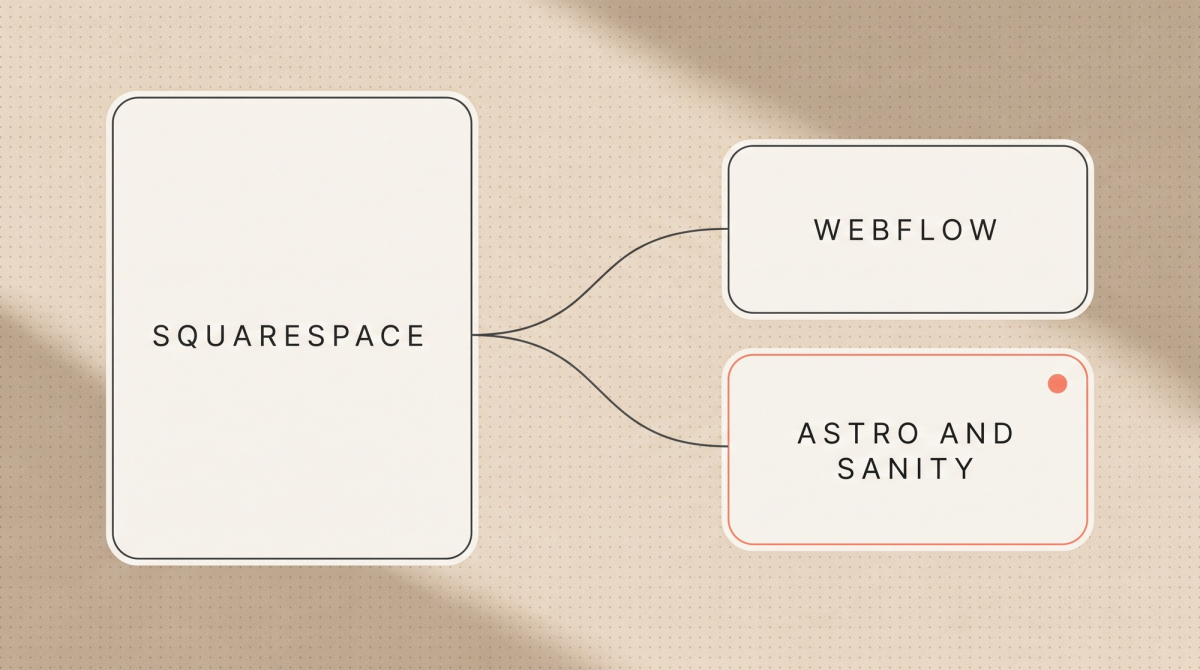
Two Squarespace alternatives are realistic for B2B companies: Webflow for websites that stay below roughly 30 pages in one or two languages, and Astro or Next.js with Sanity as soon as content needs structure, several languages or pages generated from templates. Squarespace is not badly built. It is built for a different job: small presences, portfolios, solo businesses. The builder stops right where a B2B website starts doing real work. This article shows the limits, names the cases where Squarespace is enough, compares the alternatives in a table and describes the switch.
Key takeaways
- Up to roughly 30 pages, one or two languages and no programmatically generated pages, Webflow is the right target to move to.
- With several languages, structured content types and custom templates, we build on Astro or Next.js with Sanity.
- Webflow Premium costs 25 $ per month and covers 20,000 CMS items and 40 collections, localisation starts at an extra 9 $ per language and month.
- Sanity Free includes 20 seats, 10,000 documents and 100 GB of assets, Vercel Pro costs 20 $ per month and developer seat: close to no recurring platform fees.
- Our own measurement from 13 September 2026: leanwave.com loads around 39 KB of JavaScript in three files on its homepage, a Webflow client website around 740 KB in thirteen files at the same point.
- Moving a marketing website with 10-30 pages typically takes 3-6 weeks to go live, our relaunch packages start at 8,000 € net.
The short answer
Squarespace is a website builder. Layout, rendering (meaning where and when your data turns into finished HTML) and delivery belong to the platform, and you pay a fee per website and month. As long as the website is a shop window, that holds. The moment it runs content as a system, meaning many pages assembled from reusable parts, several languages and custom templates, you hit a layout tied to a template, limited structuring of content and an export that hands you no usable structure.
The next step up is Webflow or Framer. Both give you design control down to the detail, a workable editor for your marketing team and a CMS with real fields instead of loose text blocks. The limits sit elsewhere: one template is bound to one collection, localisation costs extra per language, and hosting stays a platform fee. Our threshold: up to roughly 30 pages, one or two languages, no programmatic pages planned, then Webflow is enough.
Above that we build with Astro or Next.js and Sanity. Sanity is a structured content database your frontend reads through an API, meaning a programming interface. That gives you control over rendering, caching, schema markup, sitemap logic and internal linking at code level, multilingual setups without a surcharge per language and close to no recurring platform fees. Astro is our default, Next.js comes in as soon as login, app logic or per-request server data are part of the job.
Where Squarespace runs out for B2B websites
These limits are not a matter of taste, they follow from how a builder is constructed. You work on a surface someone else operates, and everything below it stays closed. Six points hit B2B websites again and again.

- Fee per website and month: every additional website costs again. A campaign website next to the main one, a landing page series for ads, a subsidiary brand: a new contract each time. What a website really costs over its lifetime we break down in what a B2B website costs.
- Layout tied to a template: you work inside the template. Small deviations go through injected CSS, larger ones do not go at all. A design system with your own components cannot be mapped cleanly this way.
- Limited structuring of content: a case study consists of industry, service, key figures, a quote and images. In a builder that lands as running text inside one page. You can neither filter it, nor reuse it elsewhere, nor mark it up with schema automatically.
- No access to rendering and delivery: you do not decide which JavaScript loads, how images are served or what sits in the cache. Those are exactly the levers behind Core Web Vitals.
- Multilingual only through workarounds: doing two languages properly means a separate URL per language, reciprocal hreflang annotations (the markup that tells Google which page belongs to which language), x-default set and translated URL segments. In a builder you rebuild that with add-on tools and duplicates.
- Export without usable structure: what you take with you is a dump of your text, not a content model. The field structure, the relations and the templates stay inside the platform.
When Squarespace is enough
There are cases where switching burns money. For small presences Squarespace delivers a decent result quickly, without developers and without operational overhead. A single person showing their offer does not need a content system behind it.
Stay on Squarespace if your website stays below roughly ten pages, runs in one language, changes rarely and needs no structured content types. Portfolios, medical practices, restaurants, solo consultancies and early-stage founders before their first funding are well served there. As an interim solution during a founding phase, a builder is honestly the sensible choice.
The point to switch arrives when three things line up: the website should generate leads instead of merely existing, recurring content types such as case studies, knowledge articles or product pages are coming, and a second language is on the roadmap. For single campaign pages next to the main website, a dedicated landing page beats a second builder subscription.
Squarespace, Webflow and Astro with Sanity compared
The table compares the three routes along the criteria that actually decide whether a B2B project works. We do not quote Squarespace prices, we have not verified them.

Squarespace, Webflow and Astro with Sanity compared
| Criterion | Squarespace | Webflow | Astro or Next.js with Sanity |
|---|---|---|---|
| Recurring platform fee | Fee per website and month | Premium 25 $/month plus workspace from 19 $ | Vercel Pro 20 $/month per developer seat, Sanity Free 0 $ |
| Layout and design control | Bound to the template | Free design in the editor | Free design in code, your own design system |
| Content structure | Pages with text blocks | CMS with fields, 20,000 items, 40 collections | Custom content model, Sanity Free with 10,000 documents |
| Multilingual setup | Through add-on tools and duplicates | Add-on from 9 $ per language and month | No surcharge per language, translated URL segments |
| Access to rendering and cache | Not available | Not available | Fully available in code |
| JavaScript on the homepage | Decided by the platform | Measured around 740 KB in thirteen files | Measured around 39 KB in three files on leanwave.com |
| Programmatic pages | Not intended | One template per collection | Any number of templates, logic in code |
| Access for AI agents | Restricted | Official MCP server and API, item limits | API and MCP server, plus rendering and schema |
| Export and switching | Text dump without structure | HTML, CSS, JS, without CMS content and interactions | Content as NDJSON, code in your own repository |
| Who works with it | Marketing alone | Marketing plus designer | Editors in the studio, developers for templates |
Webflow and Framer as the next step
Webflow is the honest middle ground, and we say that as a certified Webflow partner who maintains existing clients on it. Design control, editor and delivery speed are genuinely strong, the CMS has real fields, and your marketing team works on content without a developer. For many B2B websites that is the right jump away from a builder. More candidates are sorted in our overview of Webflow alternatives.
The numbers: Starter is free with 50 CMS items, Basic costs 15 $ per month without CMS, Premium 25 $ per month with 20,000 CMS items and 40 collections. On top comes the workspace from 19 $, Growth sits at 49 $. Localisation is an add-on: 9 $ per language and month up to three languages, 29 $ per language up to ten. Whether the main language counts is not stated on the pricing page. The CMS limits in daily use: 40 collection lists per page, 10 nested, 100 items per list without pagination.
Framer is faster at designing and publishing, but weaker at structured content. Where the differences sit in detail is covered in our Webflow and Framer comparison. The hard point is the same for both: the export delivers HTML, CSS and JavaScript, but not the CMS content and not the interactions. If you want to start on Webflow directly, our Webflow agency takes it from there.
Astro or Next.js with Sanity as our recommendation
Once content becomes a system, the question moves from the tool to where the data lives. Your content sits in a content database, your frontend renders it, and each side can be replaced without the other. What defines such a setup is explained in our introduction to headless CMS, the product details sit with Sanity.
Astro 7 ships zero client-side JavaScript by default for static content and renders components to HTML and CSS. Interactivity is requested on purpose: client islands load their JavaScript separately, only the interactive part is hydrated, the rest stays static HTML. Server islands render personalised parts separately via `server:defer` while the main page is delivered immediately. How the framework is put together is covered in Astro as a framework.
The cost side stays small. Sanity Free covers 20 seats, 10,000 documents, 100 GB of assets and 100 GB of bandwidth per month, including presentation mode and visual editing, where your editors see changes directly in the preview. Growth costs 15 $ per seat and month with 25,000 documents. Vercel Pro sits at 20 $ per month and developer seat including 20 $ of usage credit, with no base fee per project.
One detail that is often told wrong: Webflow, Wix, Contentful and Storyblok also run official MCP servers, meaning interfaces through which AI agents can create and check content. The difference is not the access, it is what sits behind it: item and collection limits, one template per collection, API rate limits, and no access to rendering, caching, schema, sitemap logic and internal linking in code. And programmatic pages only work with real substance per page, otherwise Google downgrades them as doorway pages, meaning pages that exist only to cover a keyword. We experienced that on our own old website.
Why WordPress is not an alternative for us
WordPress shows up in every list of builder alternatives, so here is our position in plain words: we do not work with WordPress and we do not offer headless WordPress either. That is not a matter of taste, it is arithmetic.
Rebuilding to headless costs the full relaunch effort and still leaves the WordPress installation standing, with its updates, plugin dependencies and attack surface. That leaves two systems to maintain where there was one. Coming from a builder, you would trade one dependency for two. The single exception: business logic hangs on that installation and cannot be replaced quickly, for example WooCommerce, a membership system or an ERP interface. Then headless is a transitional setup with an end date, not a permanent state.
A company leaving WordPress moves to Sanity with a custom frontend, with no intermediate step. Which other routes exist and who they suit is covered in our overview of WordPress alternatives.
When Webflow, when Astro with Sanity
The decision comes down to three numbers: page count, languages and content structure. Everything else follows from those. If you are torn between the two routes, ask whether your content should be generated from templates in future or built page by page.
Choose Webflow if
These cases are well served by Webflow, and we build them that way ourselves.
- Your website stays at up to roughly 30 pages, in one or two languages and without programmatically generated pages.
- Your marketing team should be able to change layouts without a developer deploying anything.
- You need a visible result within a few weeks and have no development team in house.
- A platform fee plus a localisation add-on from 9 $ per language and month is acceptable to you.
Choose Astro with Sanity if
Past this point the builder route stops carrying, and Webflow turns into a brake rather than a shortcut.
- You plan more than 30 pages, several languages or translated URL segments such as /solutions and /de/loesungen.
- Your content consists of recurring types with fields, from which pages and listings are generated automatically.
- You want to control rendering, caching, schema markup and internal linking yourself.
- Recurring platform fees per language and per website should disappear, and multilingual costs no surcharge with us.
How the move away from Squarespace works
The move is a relaunch project, not a file transfer. Because a builder export delivers no usable structure, we rebuild the content model and transfer the content into the new fields. The sequence applies regardless of the source system and is written up in full in our guide to CMS migration.
Crawl and ranking snapshot first:
we pull every existing URL with Screaming Frog or Ahrefs and record the ranking position before anything changes.
Content inventory and content model:
every page is assigned a type, and the recurring types become the model in Sanity.
Build in Astro or Next.js:
templates, components, hreflang annotations, schema, sitemap and internal linking are created in code.
Redirect map 1:1:
every old URL gets a permanent target via 301, without chains, pointing straight at the new address. How rankings survive that is covered in relaunch without SEO loss.
Launch and submission:
launch checklist, submission to Search Console and Bing, IndexNow to report new URLs quickly.
Two weeks of monitoring:
a 404 report and a ranking comparison, plus rework wherever something stands out.
For a marketing website with 10-30 pages the timeline is typically 3-6 weeks to go live, with monitoring on top. We bill it as a relaunch project, and our packages start at 8,000 € net. The delivery is handled by our website relaunch agency.
Our verdict
We have made the move ourselves. in-sync.io ran on Wix and moved to Next.js, Sanity and Vercel in 2026: 49 knowledge articles, 10 service pages and 17 city pages out of one Sanity database, bilingual with hreflang, server rendering, llms.txt, IndexNow and FAQPage schema. Plain words on the outcome: the old builder website ranked for close to nothing, the new one has been live since June 2026 and is building its rankings. What is specific about leaving a builder is written up in migrating Wix to Next.js.
For client projects Astro with Sanity is our default. LeanWave (Otto ID Solutions) sells RFID solutions for textile services and laundries and runs statically on Astro with Sanity, Tailwind and Vercel: bilingual with English on the root and German under /de, translated URL segments, reciprocal hreflang including x-default, 64 documents, 86 image assets and a rebuild via webhook, meaning an automatic rebuild on every change. Yarowa shows the other direction: five languages, originally built in Webflow, ported by us 1:1 to Astro, 21 page templates and 163 sections, design unchanged.
If you are on Squarespace today and the website is meant to carry leads next year, the decision is rarely close. Below roughly 30 pages and one or two languages you take Webflow. Above that, or when content should come from templates, you take Astro with Sanity.
Frequently asked questions
Webflow, if the website stays at up to roughly 30 pages in one or two languages. Astro or Next.js with Sanity as soon as several languages, recurring content types or programmatically generated pages come into play. Webflow Premium costs 25 $ per month, while an Astro website on Sanity Free typically runs at 0-20 $ hosting per month.
A fee per website and month, a layout bound to the template, limited structuring of content, no access to rendering and delivery, multilingual only through workarounds and an export without usable structure. For a portfolio none of that shows. For a website with case studies, knowledge articles and two languages, every point does.
You get text and images out, but not the structure. Field setup, relations and templates stay inside the platform. That is why we rebuild the content model in Sanity and transfer the content into it instead of importing an export. With 10-30 pages that is done within 3-6 weeks.
Page count, languages and structure decide it. Up to roughly 30 pages, one or two languages and no programmatic pages: Webflow. Above that Astro with Sanity, because a Webflow template is bound to one collection and localisation costs from 9 $ per language and month on top. We pick Next.js when login or per-request server data are involved.
We bill the move as a relaunch project, and our packages start at 8,000 € net. After that, Astro or Next.js with Sanity Free typically runs at 0-20 $ hosting per month, so close to no recurring platform fees. Every additional language costs no surcharge with us.
Not if every old URL gets a permanent target. We take a crawl and a ranking snapshot beforehand, build a 1:1 redirect map with 301, resolve chains and submit to Search Console, Bing and IndexNow after launch. Two weeks of monitoring with a 404 report and a ranking comparison follow.
Next step
Send us your Squarespace address and your page count, and we will tell you in one call whether Webflow is enough or Astro with Sanity is the better route.